
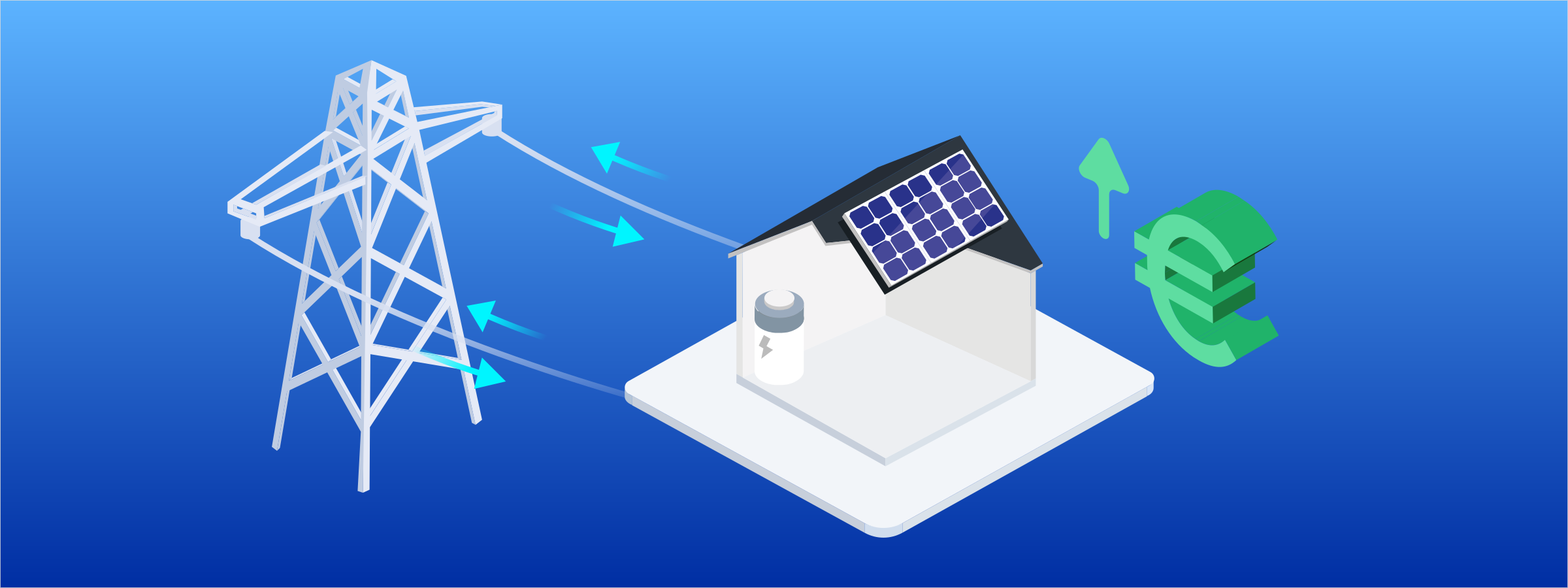
For an energy supplier, procurement costs sit at the foundation of profitability. A megawatt hour of electricity bought in peak hour can cost a multiple of the same energy bought at midday, and an imbalance position closed at short notice costs more again. Anything that shifts consumption out of the expensive hours therefore goes straight to the bottom line. Controlling the flexible assets in customers' homes is the closest thing to a direct lever on profitability. That’s why what is happening in Dutch homes right now matters more than it looks.
The Dutch paradox: all that solar, almost no batteries
The Netherlands has the EU's highest rooftop solar capacity per capita with around 1.35 kilowatts per capita. The Netherlands also experienced a massive 40x growth in terms of installed home batteries from 2021 to 2025.
Solar of course started much earlier. The Dutch just started getting batteries for a simple reason. For years, Dutch households with solar panels benefited from net metering, or salderingsregeling. The electricity a household fed into the grid was subtracted from the electricity it drew out over the year, and the difference was what it paid for. Feed in 1,500 kWh of solar and consume 4,000 kWh, and you were billed for 2,500 kWh.
In effect, the grid was the perfect battery: perfect round-trip efficiency, unlimited capacity, full retail value, no capital cost. So Dutch households bought solar panels and skipped storage altogether.
The rule that made batteries pointless is being repealed
Net metering is being phased out, with full abolition scheduled for January 1, 2027. On that date the grid stops being a free, unlimited, full-price battery. Surplus solar has to go somewhere, and the only somewhere left in the house is a physical one.
And it is showing up in what people install: the Netherlands experienced a 40x growth in terms of installed home batteries from 2021 to 2025. The direction is unambiguous, even if the installed fleet of PV will likely take years to catch up.
So is battery arbitrage a lever energy providers can use?
For anyone whose job is buying energy, a growing fleet of household batteries raises an obvious question: Can they be used for arbitrage?
What is battery arbitrage?
Battery arbitrage means buying electricity when it is cheap, storing it and discharging it back into the grid when electricity is expensive. The battery earns its keep on the price spread, which is the gap between the low price at charging time and the high price at discharging time. Buy low, store, sell high, repeated across the daily swings of the power market.
It happens at every scale, from battery energy storage systems trading directly on wholesale markets to a home battery reacting to hourly prices. What makes battery arbitrage work is volatility, and the widest spreads are usually not on the day-ahead market but on the intraday market, where continuous trading right up to delivery produces bigger swings.
And there is earning potential. Look at residual load, meaning total demand minus renewable generation. As solar grows, midday residual load collapses and the daily shape develops the pattern known as the duck curve. The chart compares a typical day's residual load in the Netherlands in 2016 with the same metric in 2026.
.svg)
In June 2026, Dutch day-ahead prices topped 800 euros per MWh on several days. So there is huge savings potential with battery arbitrage. With more solar and wind on the system, that volatility is not going away.
All of that should be ideal for battery arbitrage, right?
The issue is that batteries already have a job
Most batteries arriving in Dutch homes today are bought to absorb the household's own solar generation. That is their day job, and it has the first claim on their capacity. What a supplier can trade with is what is left over. The only exception would be a big price spread in the market that outperforms self-consumption optimization. And that remainder is not a fixed number. It moves hour by hour with the weather, with the household's consumption and with the electricity price curve.
And the available battery capacity for selling is at its thinnest exactly when the market is at its most valuable, which is the evening peak, when the household wants a full battery too. For an energy provider that wants to lower procurement costs, that creates tension. If done correctly this tension can be avoided.
The tension suppliers face
A supplier's trading desk wants to flex as much as possible, because using flexibility can meaningfully lower procurement costs. But every kilowatt hour of battery capacity used for trading is capacity that is not available for the household's own self-consumption. With weak optimization logic, the customer could end up buying more grid electricity over the year, which is the exact opposite of why they bought the battery.
A flexibility-only proposition, however good the tariff line looks, asks a customer to hand over the asset they just bought to keep their own solar energy. Few will take that deal, and the ones who do will notice. It is very unlikely that your customers will let you use their battery primarily for battery arbitrage.
The good news is that there is an alternative that makes both an energy supplier and their end customers happy.
Value stacking: Bake the cake, then add the cherry
At gridX we call the answer value stacking. And it is an approach that doesn’t start with flexibility. It starts with convincing your customers to let you manage their energy at all. You must first provide them value of some sort.
Make your customers stay
Rather than simply being an enabler for trading assets, energy flexibility is also a sales argument. A household choosing a supplier alongside a new battery is choosing whoever makes that battery pay for itself the fastest. Battery arbitrage without net metering is not the answer.
As an energy provider, you first have to solve more basic needs, like enabling customers to optimize self-consumption as the baseline, while also optimizing against a market price to reward shifting consumption to cheap hours. Then – and only then – can you incentivize flexibility.
Value 1: Self-consumption optimization
Value 2: Time-of-use optimization with market prices
Value 3: Flexibility on top
Our Senior Energy Market Expert, Irene Guerra Gil, calls flexibility "the cherry on top of the cake". The cake is the reason anyone is sitting at the table. A supplier that offers the first two values wins the customers who are buying batteries anyway, which is how the addressable fleet gets built. A supplier that leads with flexibility alone has to drive a hard bargain to get access to prosumers.
Which types of flexibility can be used profitably for end customers and energy suppliers?
With self-consumption optimization running underneath, the battery's day job is handled, and what is genuinely spare becomes visible and dispatchable. The battery discharges into the market when, and only when, the spread beats the value of self-consuming that same energy. That bar is the whole economics: clear it and both sides win, because the supplier lowers its procurement cost and the customer sees a lower bill. This is particularly doable on days with large price spreads.
.svg)
This is also where the two kinds of flexibility meet.
Implicit flexibility is the household shifting its own consumption in response to prices: charge when power is cheap, use it when power is expensive, avoid the grid, lower the bill.
Explicit flexibility is the battery being dispatched on a signal from someone else, usually the supplier's trading desk, to earn on the wholesale or balancing markets, with part of that value flowing back to the customer.
Combining both on top of self-consumption optimization is what gets the most out of a battery, and it is the core idea behind demand-side flexibility.
The Netherlands is a good place to do this
The same conditions that made the Dutch market look interesting for arbitrage work in favor of value stacking, and they are not going anywhere.
Dutch households pay grid fees based on the capacity of their connection, not on the kilowatt hours flowing through it. In other markets with per-kWh grid fees, every round trip is charged twice. And that does not incentivize flexibility. But in the Netherlands, once the connection is paid for, cycling energy in and out of a battery adds no grid fee on top – making flexibility services with a battery lucrative.
And the price signal actually reaches the household. The Netherlands has some of the highest rates of dynamic tariffs in the EU with different sources reporting between 7% (2025) and 8.8% in 2026. In most European markets, the volatility exists but never makes it past the retail tariff, which is what quietly kills the business case. Here, dynamic tariffs are slowly becoming the norm.
How value stacking is delivered
Making the call hour by hour is not something anyone does by hand. Good energy decisions depend on live forecasts of prices, solar generation and household consumption, which makes it a software problem. That is where our platform XENON comes in.
Value stacking needs a multi-asset home energy management system in the home. XENON runs self-consumption optimization as the baseline and coordinates the battery alongside other flexible assets such as EV chargers and heat pumps. Its flex layer connects to market access partners to trade the spare capacity across the day-ahead, intraday and imbalance markets whenever spreads justify it.
gridX already runs live flex products in the Netherlands, including imbalance optimization with residential batteries, and is piloting value stacking that combines self-consumption optimization with load shifting against market prices. The technology is ready ahead of the regulatory shift.
For the household, none of this is visible. They install a gridBox and the value shows up as a lower bill, not as a market to watch. Decisions are of course clearly communicated. For the supplier, the output is a flex band: a quantified, dispatchable volume that lowers procurement cost without asking the customer to give up what they bought the battery for.
What comes next: the expert view
gridX's senior energy market expert, Irene Guerra Gil, sees the end of net metering as a genuine turning point for the Dutch energy transition. For a decade it delivered the rewards of storage without the hardware. As it winds down, real batteries and real optimization move to center stage.
According to Irene, the next frontier is already on the horizon: the electric vehicle. Today gridX does smart charging, shifting electric vehicle (EV) charging into cheap hours, but not yet true vehicle-to-grid arbitrage. That is mainly blocked by regulation rather than technology, since gridX is already tapping that potential with customers in other markets today.
"Using a battery only for trading is becoming a thing of the past in the Netherlands. As net metering ends and feed-in charges come in, batteries are needed for self-consumption again. That means the smart strategy is value stacking: self-consumption optimization as the baseline with flexibility as the cherry on top, activated only when the market makes it worth it. The market is and will be volatile enough that flex will always have value and we're technically ready to capture it today."
Irene Guerra Gil, Senior energy market expert, gridX