Connectivity Report 2026

Executive summary

Connectivity is turning Europe’s growing DER base into a flexibility opportunity

01

The DER boom is coming: Germany had its highest ever monthly EV registrations in June 2026 (84,000); nearly 3 million Dutch homes already have rooftop solar; and UK monthly solar installations reached a record 17,000+ in early 2026. Different paths but same trend toward multi-asset homes.

02

Cloud connectivity turns EVs into an immediate savings opportunity. essent’s Slim Laden shows the potential, enabling customers to save up to €300 per EV per year by shifting charging to lower-cost hours without additional hardware.

03

Value stacking increases the value of connected assets. By combining flexibility, dynamic tariff and self-consumption optimization, connected assets can deliver annual value of up to €1,500 in Germany, £1,700 in the UK and €1,275 in the Netherlands,.

04

63% of gridBox installations take place in under 10 minutes. E.ON end customers are completing self-installation by themselves, while Koehrer Solar uses remote commissioning to reduce time on-site.

05

Europe’s energy sector faced 23 cyberattacks between 2022 and 2026. As NIS-2, and the Cyber Resilience Act raise security requirements, gridX continues to strengthen its cybersecurity practices, achieving a CyberVadis score of 895/1,000.

06

The Ready for gridX partnership enables pre-validated integrations and proactive firmware updates to deliver 75% fewer support tickets. Hear from the seven Ready for gridX partners how the program helps them.

1. The DER boom

gridX Connectivity Report 2026 on connecting distributed energy resources across European homes

Millions more energy assets are entering Europe’s homes

Europe’s residential energy system is expanding across every major asset category. Between 2020 and 2030, PV capacity is expected to increase by 5.2x, yearly EV registrations by 3.5x, total installed heat pumps by 4x and residential battery capacity by an increasible 38x.

But growth alone is only half the story. As PV, batteries, EVs and heat pumps increasingly co-exist in the same homes, what were once individual devices need to become interconnected energy systems, where flexibility is leveraged at scale.

02. Hybrid connectivity: Millions of assets. More than one way to connect them

gridX Connectivity Report on connecting distributed energy resources including EVs, solar, batteries and heat pumps

Europe already has around 69.5 million residential DERs, with around 15 million installed across Germany, the Netherlands and the UK alone. Connecting this diverse asset base requires more than one approach.

For compatible assets, cloud connectivity can scale rapidly – essent migrated thousands of EVs in less than one quarter – while flexible EV trading can lower electricity procurement costs by up to ~50%. For heterogeneous, multi-asset homes, gateway connectivity provides the reliable local communication and real-time control needed to coordinate multiple energy assets and stack value from numerous use cases.
3. Build what differentiates you. Rely on what should simply work

gridX Connectivity Report on connecting distributed energy resources through APIs that enable energy companies to build scalable applications and services across connected energy assets.


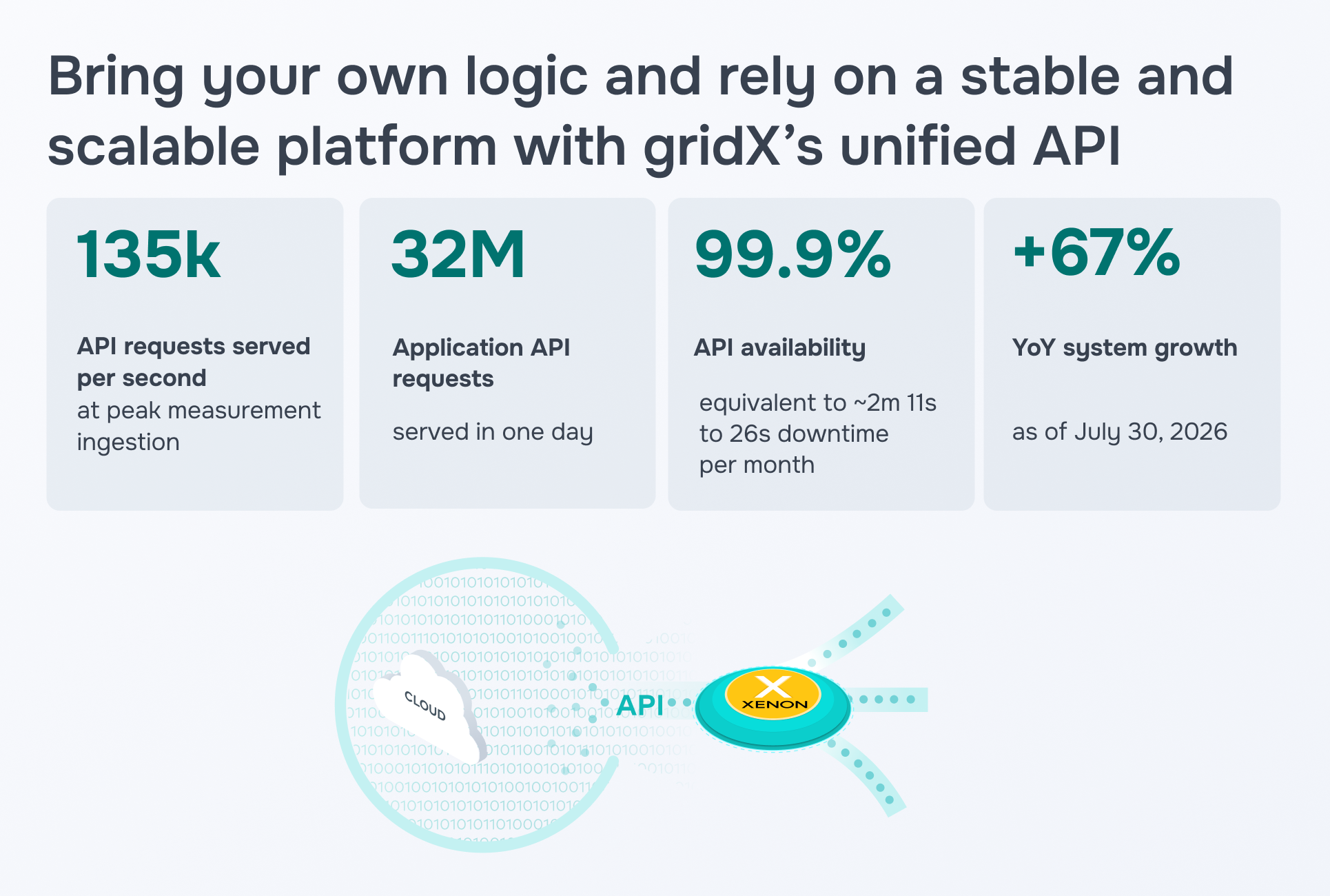
APIs provide access to specialized capabilities without requiring every component to be built from scratch. 82% of organizations already take an API-first approach, while digital business models are expected to account for 45% of utility revenue by 2033.

But flexibility also depends on what happens underneath the API: reliable asset communication, secure infrastructure and a platform capable of handling a growing number of devices and requests.gridX’s unified API allows energy companies to focus engineering resources where they create the most value – their own logic, products and customer experience – and complement with gridX’s secure, stable and scalable connectivity platform.
Get the full report!