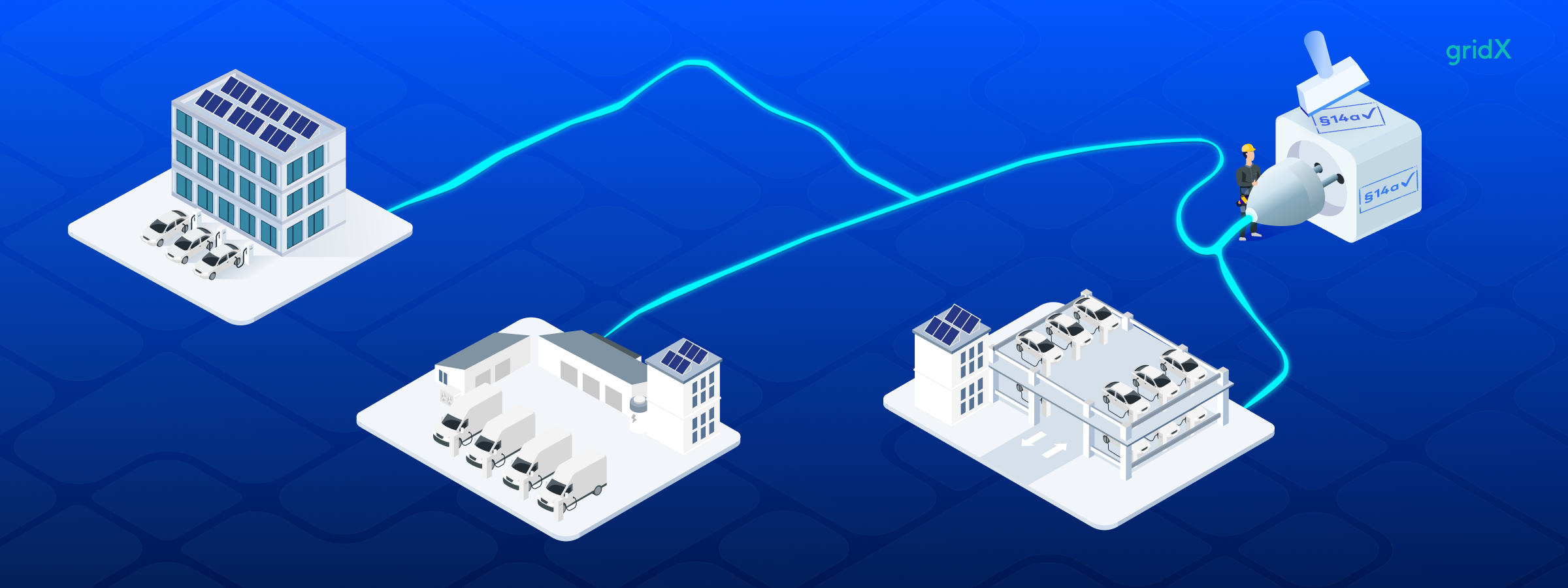
Every non-public electric vehicle charging site in Germany connected to the low-voltage grid now has to comply with §14a EnWG. But compliance shouldn’t be treated as a box to tick. With the right technology, it becomes a savings engine. Here’s how.
What §14a EnWG actually asks of you
Since 1 January 2024, the Bundesnetzagentur (BNetzA) requires every new controllable consumption device over 4.2 kW on the low-voltage grid – including electric vehicle (EV) charge points – to be steerable by the local Distribution System Operator (DSO) during grid bottlenecks, in exchange for a reduction in grid fees. §14a applies to non-public charge parks with a total demand under 100,000 kWh/year that don’t have their own dedicated transformer. In return for integrating grid signals, every eligible site is entitled to lower network charges through one of three modules.
Module 1
How it works: Flat reduction in grid fees. Best fit for smaller sites; needs no dedicated metering.
gridX’s estimated savings / site / year*: €110–190
Module 2
How it works: 60% reduction of the delivery fee, billed per kWh. Rewards volume – the more you charge, the more you save.
gridX’s estimated savings / site / year*: Up to €6,000
Module 3 (only possible in combination with Module 1)
How it works: Flat reduction plus a dynamic, three-tier grid fee schedule. Pays you for shifting charging into low-cost windows.
gridX’s estimated savings / site / year*: Up to €3,000
*gridX estimates based on real site data. Module 2: avg. 10 €ct/kWh × 100,000 kWh × 60% reduction. Module 3: avg. 6 €ct/kWh spread × 100,000 kWh × 50% utilization. Module 3 is only available in combination with Module 1. Actual savings vary by DSO tariff and site load profile.
Three modules, one solution
Choosing the right module is a key financial decision with a four-figure swing per site, per year. It depends on your site’s size, charging demand, location and scalability needs. As a general rule, Module 2 is best suited to sites with higher demand, while Module 1 and 3 are suitable for EV charging sites with lower utilitization and/or more variable grid fees.
The good news: gridX’s solution covers all modules, with dynamic grid fees as part of Module 3 being rolled out soon. The EMS enables an automated response to DSO grid signals across every charge point – no manual intervention needed, no risk of missing a curtailment event. On top of this, the Operator Dashboard provides full transparency on potential limitations, with full historical data on what was curtailed when.
gridX’s new zero-curtailment protection feature protects every charger on site with a minimum power floor during load curtailment. This means that even when §14a limits are highly restrictive, the load management ensures EVs are not shut-off entirely to maintain charging comfort.
Compliance is the requirement. Optimization is the business case.
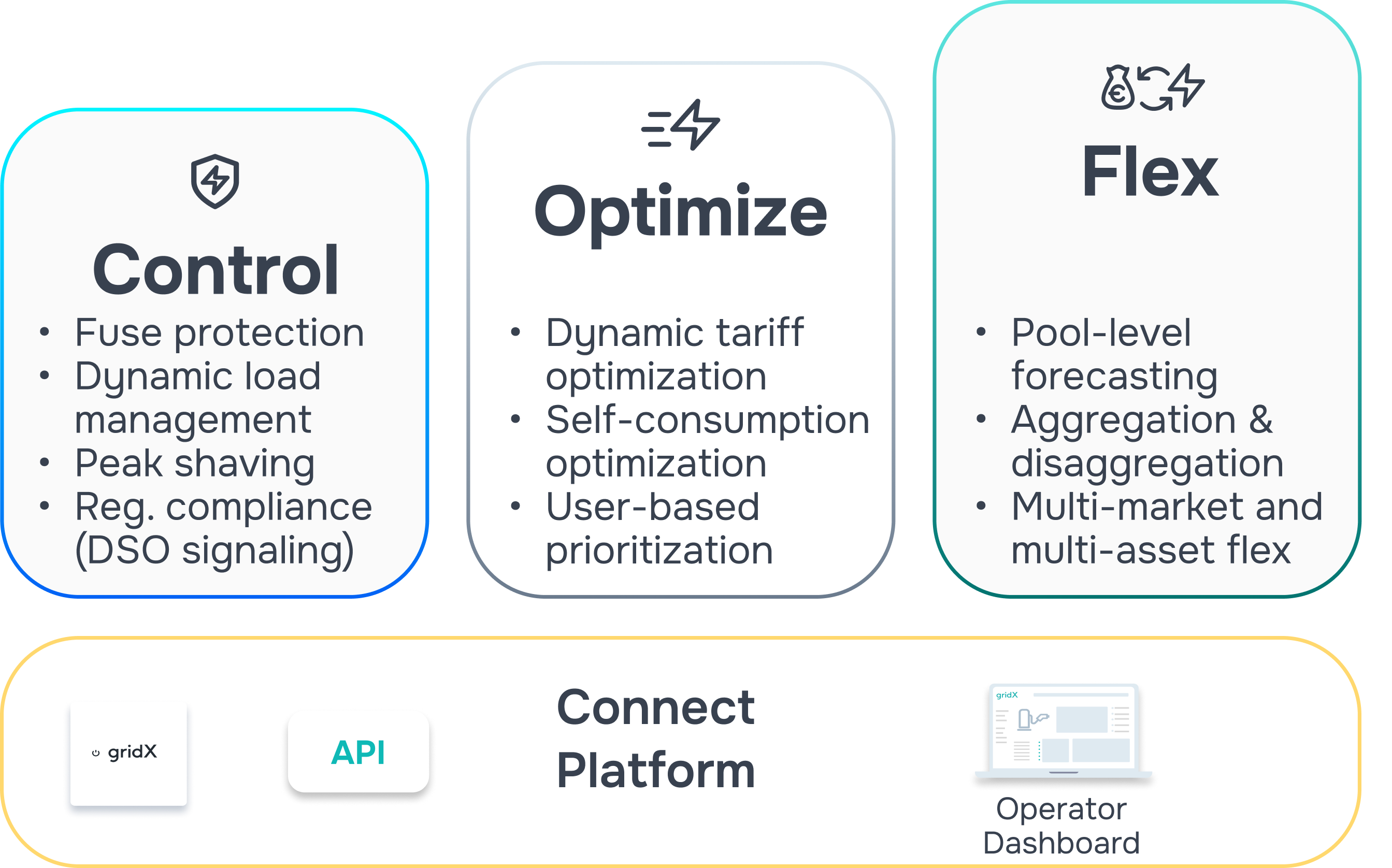
Here's what most §14a guides won't tell you: the grid fee reduction is only half the opportunity. gridX's Energy Management System (EMS) doesn't just make your site compliant – it stacks §14a savings on top of dynamic load management, peak shaving, dynamic tariff optimization and explicit flexibility services, all orchestrated by the same platform. That means:
- Smarter load shifting: dynamic load management keeps every site within grid limits while intelligently distributing power across chargers. This means more chargers on each site, every one of which can behave in a grid-friendly manner.
- Dynamic tariff optimization: automatically shift charging to periods when electricity prices are low, a natural complement to Module 3's time-variable grid tariffs.
- Lower peaks, lower bills: peak shaving reduces demand charges on top of §14a's grid fee cut – two savings levers, one platform.
- Monetize EV flexibility: Pool the flexibility of your EV fleet at (semi) public charging sites into a market-ready portfolio and optimize procurement for trading on wholesale markets to save up to €6000 per vehicle per year.
First-mover advantage, built in
Layer these features together and the €110-€6,000 per site shown above is a floor, not a ceiling. §14a EnWG is still new territory for most of the market – the registration process, module selection and signal-response logic are unfamiliar even to experienced operators.
Carsten Schäfer, Regulatory Affairs and Innovation Lead at gridX explains: “gridX built its EMS to handle §14a from day one, giving charge point operators and e-mobility providers a regulatory-first-mover position. By implementing compliance in combination with other features around the customer’s specific needs, gridX removes the complexity of new regulation, while also maximizing overall savings.”
§14a compliance is mandatory. The savings it unlocks are optional – and most operators are leaving them unclaimed because the regulation is complex to navigate. gridX turns that complexity into a single platform decision: plug in, stay compliant and let the automatic optimization do the rest.
Ready to see what your sites could save under §14a EnWG? Get in touch.