
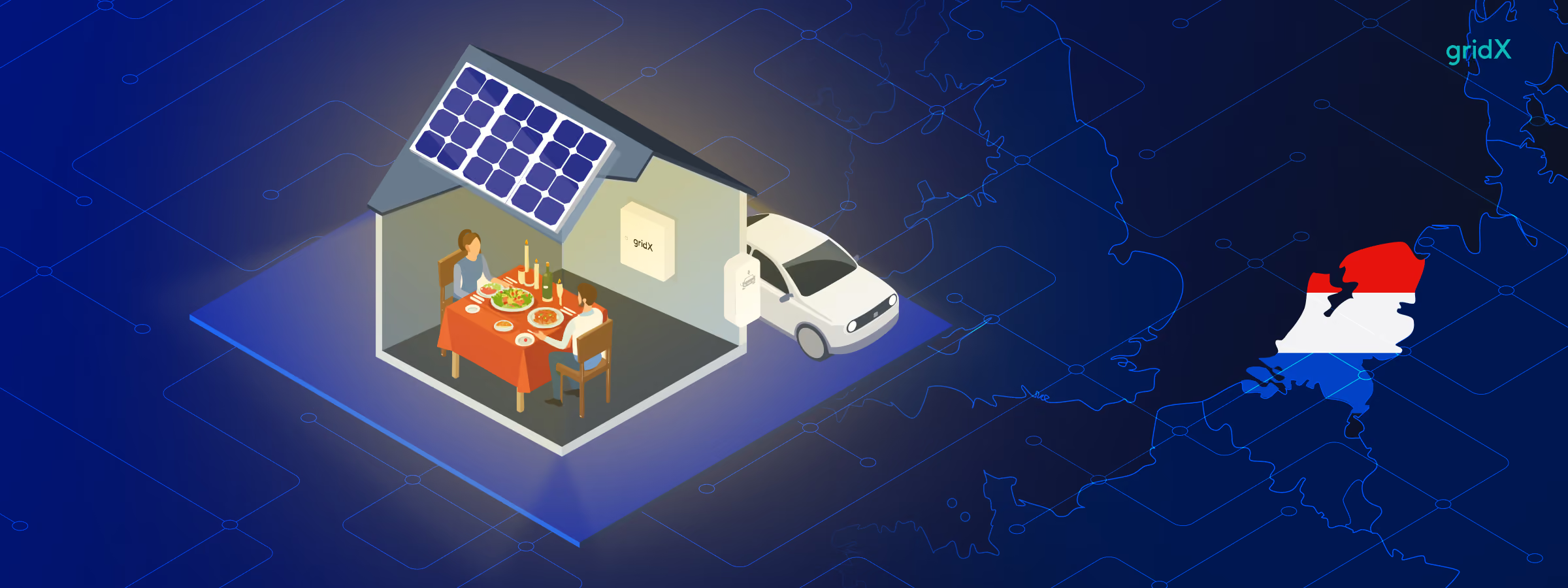
This November, the Dutch government launched its new “Think Ahead” (Denk Vooruit) campaign, urging citizens to prepare for potential emergencies, such as being without water, power or internet for up to 72 hours. This initiative highlights a growing national focus on resilience and energy security, but it also opens a powerful opportunity for energy providers: helping households take control of their energy future through smart energy management.
Denk Vooruit, led by the Ministry of Justice and Security together with the Netherlands Institute for Public Safety (IFV), aims to raise national awareness around crisis preparedness. The campaign’s message, that citizens should be ready to cope independently for 72 hours, reflects a broader government push to strengthen the country’s resilience in the face of climate change, cyber risks and energy supply disruptions. For the energy sector, this focus on preparedness highlights how critical digitally- connected decentralized energy systems have become in guaranteeing a stable energy supply. When local generation, battery storage and smart control systems are in place, individual households and communities can keep the lights on even when the wider grid is under stress.
Why Denk Vooruit?
The Denk Vooruit campaign encourages people to be self-reliant in times of crisis – stocking essential supplies, having backup lighting and making plans for when utilities go down. For the energy sector, this message aligns perfectly with the evolving Dutch energy landscape: one where prosumers (energy-producing consumers) and flexumers (flexible energy consumers) are becoming key players in a decentralized grid.
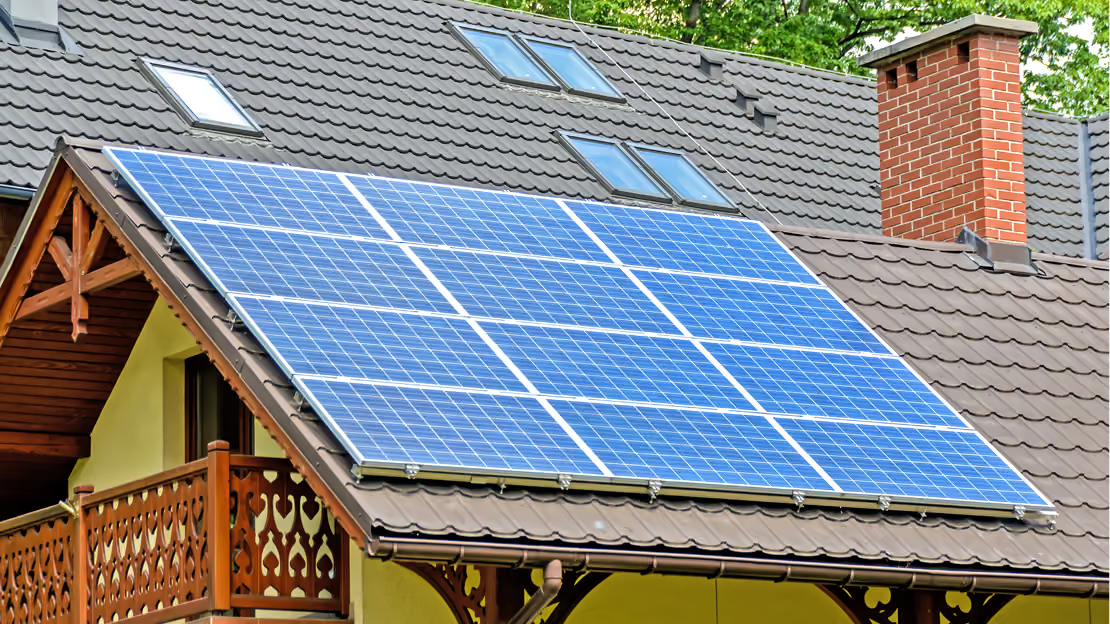
By combining solar generation, home batteries and home energy management systems (HEMS), households can store their own energy and use it when they need it most, not just during emergencies, but also when market prices spike or the grid becomes unstable.
From home resilience to grid stability
Imagine a typical Dutch household on a windy winter evening. Grid prices surge as national demand peaks and a local power line goes down due to storm damage. When equipped with the right hardware – such as an inverter with an off-grid or emergency power function – and paired with a battery and HEMS, a home can remain temporarily supplied with its own stored energy. Not all inverters support this functionality and many standard installations shut down completely during an outage. Only systems designed for off-grid or backup operation enable a seamless transition to stored power.
But while short-term backup power is possible, the real systemic value lies elsewhere. A digitally coordinated home, with assets like solar PV, BESS, EV chargers and heat pumps, can act as a flexible connection in the energy ecosystem. When combined with a smart HEMS, these devices automatically shift consumption away from peak moments, absorb surplus renewable generation and discharge when the grid needs support.

These micro-level actions, multiplied across thousands of households, translate into macro-level resilience. Prosumers and flexumers become active partners in grid stability, helping utilities reduce congestion, minimize costly curtailment and maintain balance in an increasingly renewable system.
Resilience plus efficiency
Household energy independence isn’t solely about riding out a blackout – it’s about using energy more intelligently every day to support both households and the wider grid. With a HEMS such as XENON, consumption and storage are continuously optimized based on real-time prices, forecasted generation and grid conditions.
While homes equipped with the right inverter and battery can maintain limited functionality during outages, their broader value emerges in daily operations. They can use self-generated solar energy long after sunset, reduce exposure to peak tariffs and smooth demand patterns that would otherwise put pressure on distribution networks.
This level of intelligent flexibility transforms Denk Vooruit from a preparedness message into a practical strategy for stabilizing the grid while empowering consumers.
Net metering phaseout: The perfect catalyst
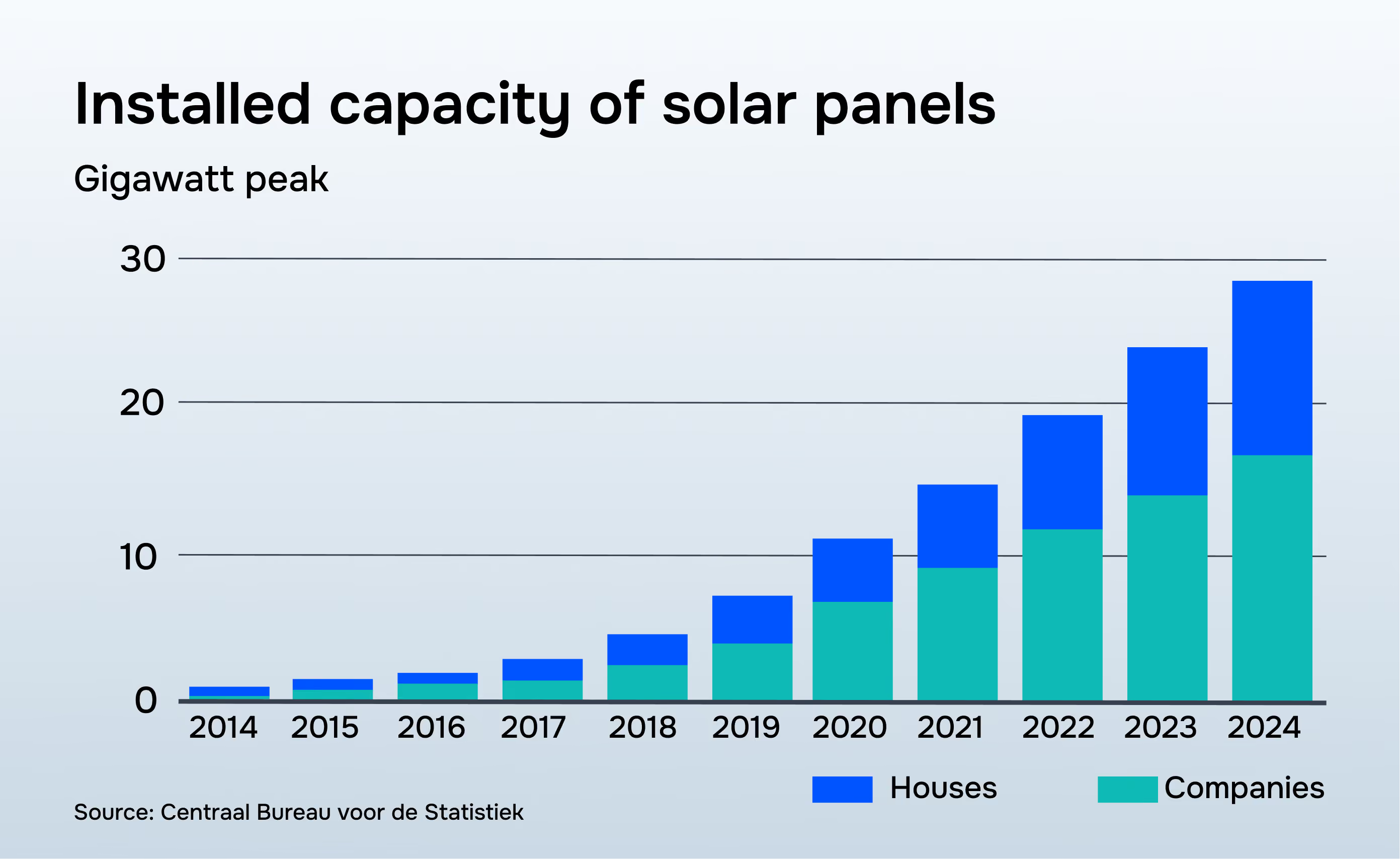
As of January 1, 2027, the Netherlands will end its net metering (salderingsregeling) scheme for solar panels. Previously, the scheme allowed prosumers to offset their electricity consumption by exporting surplus solar power to the grid. It operated on a one-to-one basis, meaning prosumers could deduct the electricity they exported from their total consumption at the same retail rate. This played a crucial role in driving the adoption of rooftop photovoltaic (PV) systems, which rose to a 28.6 GW-peak of installed solar capacity in 2024.
The Dutch government has already begun phasing out the scheme. When it disappears completely in 2027, solar panel owners will face fees for feeding excess power into the grid, making it increasingly less profitable – and, at times, actively discouraged – to export electricity.
For many households, this is a wake-up call. For years, the generous one-to-one compensation model helped accelerate rooftop solar adoption, but it also created challenges: grid congestion, volatile feed-in peaks and mounting costs for utilities. As more energy flows back into the system than is consumed locally, maintaining balance becomes complex and expensive.
The new framework pushes the market toward smart self-consumption rather than mass export. This shift opens opportunities for energy providers to innovate by offering flexible, dynamic tariffs, localized energy communities and smart storage solutions that align consumer incentives with grid needs.
The new framework pushes the market toward smart self-consumption rather than mass export. As a result, demand for storage will rise significantly, particularly because many Dutch households installed PV without batteries when net metering eliminated the financial incentive to consume energy locally. While adding a home battery represents a higher upfront investment, a large share of Dutch homeowners already own EVs, making solar EV charging the most accessible first step toward self-consumption. A smart HEMS can immediately optimize charging with surplus generation, reducing costs from day one, while also future-proofing the home for further upgrades like battery storage or heat pumps. For energy providers, this shift creates new opportunities to deliver scalable, value-stacked offerings that align consumer incentives with grid needs.
Imbalance optimization: How grid balancing is supported by smart energy management
The end of net metering doesn’t close a door. It opens one to a more efficient, data-driven and collaborative energy ecosystem. As households store surplus solar energy instead of exporting it, they help alleviate pressure on an already congested grid. With smart HEMS technology, stored energy can be deployed not only during expensive peak hours, but also when the grid signals a demand for flexibility.
Beyond household optimization, smart energy systems enable imbalance optimization, a critical function in the Dutch energy market. Imbalances occur when supply and demand deviate from forecasted values, triggering costly balancing actions. By aggregating and orchestrating thousands of distributed assets, an energy management system (EMS) like XENON can charge batteries when excess renewable generation is available and discharge when shortages arise – actively contributing to grid stability in real time.
While systems with an appropriate inverter can provide short-term backup power during outages, their broader strategic value lies in strengthening overall grid resilience. Smart energy management transforms decentralized assets into responsive, flexible infrastructure that supports utilities, integrates more renewable energy and reduces volatility.
A call to energy providers: Enable the “Think Ahead” future
The energy transition isn’t just about more renewables. It’s about empowering people to use them intelligently. Energy providers and utilities in the Netherlands are uniquely positioned to:
- Offer integrated solar + battery + HEMS packages.
- Provide dynamic tariffs that reward smart consumption.
- Partner with digital platforms like gridX to enable automated, data-driven energy optimization.
Together, these solutions help transform the Denk Vooruit preparedness campaign into a sustainable, consumer-centric energy revolution.
Denk Vooruit and invest in smart energy now
The Dutch government’s “Denk Vooruit” message is timely. As Fabian Wolf, gridX Team Lead of Customer Success Management, says, “True resilience goes beyond stocking candles and flashlights; it represents a move toward energy autarky. It's about building an energy system where every household can stand strong – not as a dependent consumer, but as a self-sufficient node in the grid. Smart energy systems are not only safeguards for emergencies, they are the foundation of a future-proof, decentralized economy where energy independence is the standard, not the exception.”

As electrification accelerates and millions of EVs, heat pumps and solar installations come online, managing this complexity will require intelligence at every level, from individual homes to national grids. With digital platforms like gridX’s XENON, Dutch utilities can seamlessly orchestrate decentralized assets, unlock new revenue streams and deliver unparalleled value to customers.
Preparedness starts with people. Resilience starts with data. Together, they define the next chapter of the Dutch energy transition.Think ahead. Invest in smart energy management. Empower your customers. Strengthen the grid. And lead the Netherlands toward a more resilient, flexible energy future.