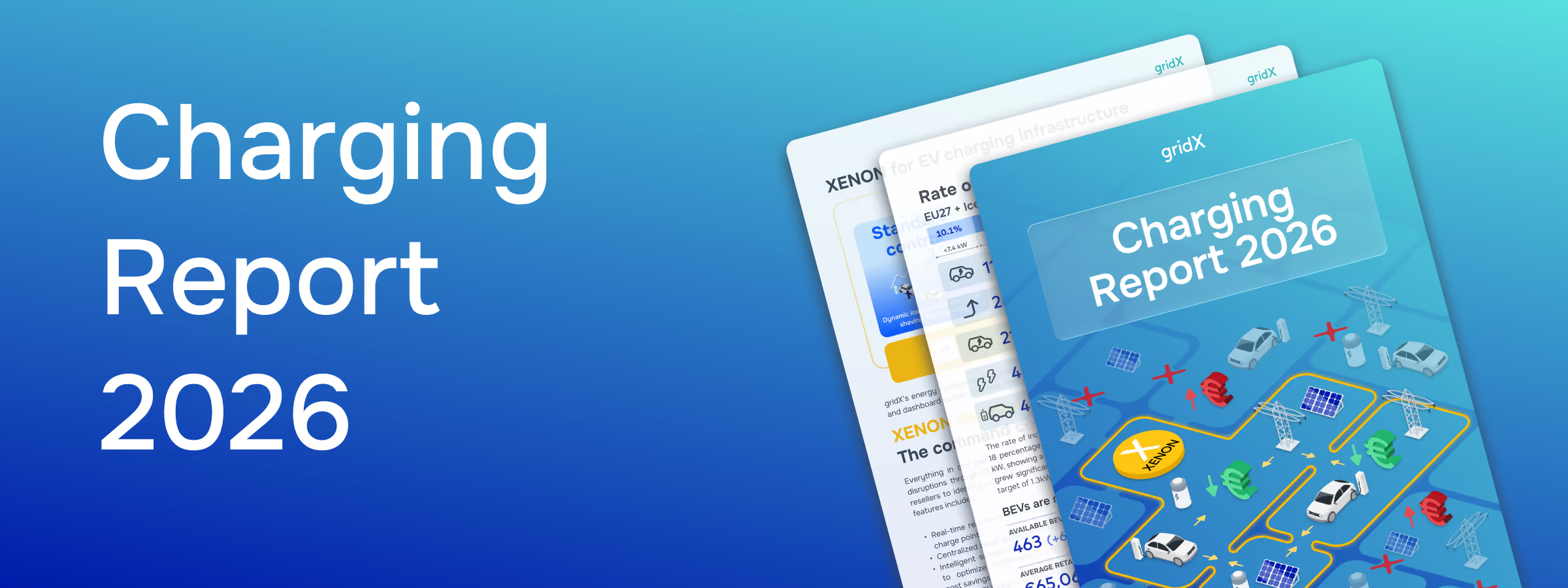
Aachen, Germany, April 20, 2026 – gridX, one of Europe’s leading energy management system (EMS) providers, has published its 2026 Charging Report. The report focuses primarily on public EV charging but also includes findings on home charging, compiling data from the 27 member states of the European Union as well as Switzerland, Liechtenstein, Norway, Iceland, and the United Kingdom (collectively: ‘Europe’, ‘focus countries’). For 2025, the report notes, among other things, that the United Kingdom (UK) has the fourth highest number of public charge points and ranks third in terms of number of installed ultra-fast chargers. The report finds that the Netherlands has the highest number of public charge points and the highest charge point density per capita.
More than one-tenth of passenger cars registered in Europe are fully electric
11,398,731 all-electric passenger cars (BEVs) were registered in Europe last year, representing a slowdown in growth compared to the previous year (2025: 27.7%, 2024: 35.2%) and an increase of 2,471,194 BEVs. In 2025, 11.3% of all registered passenger cars were BEVs (2024: 8.0%), with 21.4 BEVs per 1,000 inhabitants (2024: 17.8/1,000), representing an increase of 3.6%. The number of available BEV models increased to 463 (2024: 400), with an average range of 390.3 kilometers (2024: 389.2 km) and an average starting price that fell by approximately €2,800 to around €65,100.
The number of public charge points in the 32 focus countries covered by the report stood at 1,215,706 in 2025, representing a near five-fold increase over five years (2020: 251,356) and a 19.1% increase compared to the previous year (2024: 1,020,499); in 2024, year-on-year growth stood still at 36.8%. The number of charge points per 1,000 inhabitants nearly doubled compared to 2024, reaching 3.9 (2024: 2.0/1,000).
Throughout 2025, Europe’s 38.5% growth rate of public direct current (DC) charge points was more than double that of alternating current (AC) charge points (15.3%). At the same time, the share of ultra-fast chargers rose from 9.8% in 2024 to an average of 11.8%. Both trends point to a shift in public charging infrastructure toward high-performance infrastructure, where charge point operators (CPOs) prioritize charge point power over quantity.
Regulatory requirements are clearly shaping the UK charging infrastructure
The share of BEVs in the UK’s total passenger vehicle fleet has grown steadily over the past five years (2025: 5.3%, 2020: 0.6%), while the share of BEVs in all new registrations amounted to 23.4% in 2025, having sat at just after 6.6% in 2020. The BEV with the most registrations was Tesla Model Y (2024: Audi Q4 e-tron).
The report splits charge points into four different power classes based on kilowatts (kW): slow chargers (≤7,4 kW), average chargers (7,4 kW – ≤22 kW), fast chargers (22 kW – ≤150 kW), and ultra-fast chargers (≥150 kW). The share of ultra-fast chargers was the only to increase year after year since 2021 (2025: 11.8%, 2024: 9.4%, 2023: 6.3%, 2022: 2.9%, 2021: 2.6 %, 2020: 3.1%). This was also reflected in the UK’s third-place ranking third in number of installed ultra-fast chargers (12,246) after Germany (38,138) and France (22,858).
Per capita: The Netherlands leads in charge points, Iceland in capacity
In 2025, across all 32 focus countries, the Netherlands had the highest number of public charge points (202,833, +214.7% compared to 2020), ahead of Germany (200,830, +387.5% compared to 2020), France (186,717, +397.9% compared to 2020) and the UK (103,580, +360.3% compared to 2020).
With 11.0 charge points per 1,000 residents, the Netherlands also recorded the highest charge point density, ahead of Denmark and Belgium (8.4 per 1,000 each). In the Netherlands, the share of ultra-fast chargers across all power classes increased most significantly, too (2025: +2.6%, 2020: +1.3%); however, average chargers continued to account for the largest share (2025: 95.0%, 2020: 93.0%).
Norway led in two respects in 2025: first, in the rate of newly registered BEVs per capita (178.4 per 1,000 residents), and second, in the share of BEVs among all registered passenger cars (24.0%). In terms of public charging capacity per 100 residents, Iceland led with 57.8 kW, just ahead of Norway with 52.7 kW.
Highest growth rates for new BEV registrations and DC charge points in Eastern Europe
At 82.0%, the Czech Republic recorded the highest year-on-year growth in new BEV registrations in 2025, ahead of Estonia (+75.9%) and Belgium (+74.3%). Several Eastern European countries also confirmed the rising popularity of DC charge points. The three highest growth rates in Europe in 2025 were recorded in Latvia (+142.8%), Estonia (+122.9%), and Poland (+103.7%).
Charge point operators view energy management as decisive for success
A survey of four CPOs from the gridX partner network operating across Europe revealed that they view securing sufficient local grid capacity as the biggest challenge in expanding public charging infrastructure.
They named an EMS platform like gridX’s XENON – which is reliably scalable and helps unlock a charging station’s full flexibility potential – as an essential tool for success. They unanimously expected flexibility to become a significant business driver by 2030 and cited cost-efficiency and additional revenues as the main drivers guiding a flexibility product portfolio. Three of the four surveyed CPOs identified flexibility forecasting, aggregation, and disaggregation as the most complex aspects.
They also unanimously stated that, in addition to a smart EMS, they intend to add battery storage to their charging stations by 2030. In the short term, battery storage counteracts the high costs of grid connection expansion and helps significantly reduce grid fees; in the long term, it forms the basis for flexibility marketing and the associated new revenue streams.
Guillaume Goijen, Director of Charging Technology of the Dutch fast-charging network operator Allego, comments: “Allego is making sure that energy is balanced, locally and across energy markets. To ensure scalable and reliable infrastructure, we work together with gridX for local physical load balancing using the latest communication protocols and integration with grid operators to ensure the optimal performance of the overall electricity grids. We balance for the perfect customer experience.”
Anne Bicking, CEO of gridX, notes: “Without orchestration, growth in electric vehicle charging creates new constraints. We are thus moving from infrastructure expansion to intelligent connectivity and flexibility. What sets energy and e-mobility players apart now is not scale alone but how intelligently that scale is managed and monetized. The next phase of EV adoption will be defined by how effectively distributed assets are turned into coordinated, flexible systems.”
Editorial notes
In 2025, gridX’s energy management offering for public charging infrastructure included 1,157 installed EMS (2024: 625) optimizing 12,851 public charge points (2024: 8,342) across 15 European countries.
The report is available for download here.
Further details regarding the terms and categories used in this press release and in the report can be found on page 2 of the report under “Things to note”.
The sources for the external figures and percentages used in this press release that were not collected or calculated by gridX are listed on pages 31 and 32 of the report.
gridX is Europe's leading smart energy company based in Aachen and Munich. With its energy management platform, gridX seamlessly connects, controls and optimizes distributed energy resources in home and at electric vehicle charging sites. Customers can monetize the flexibility of energy assets as gridX aggregates their capacity and makes it available for trading on various energy markets. Energy retailers and scale-ups unlock new revenue streams and provide their end customers with more value and lower bills. Charge point operators can install more and higher power charge points, while lowering costs.