What is AgNes?
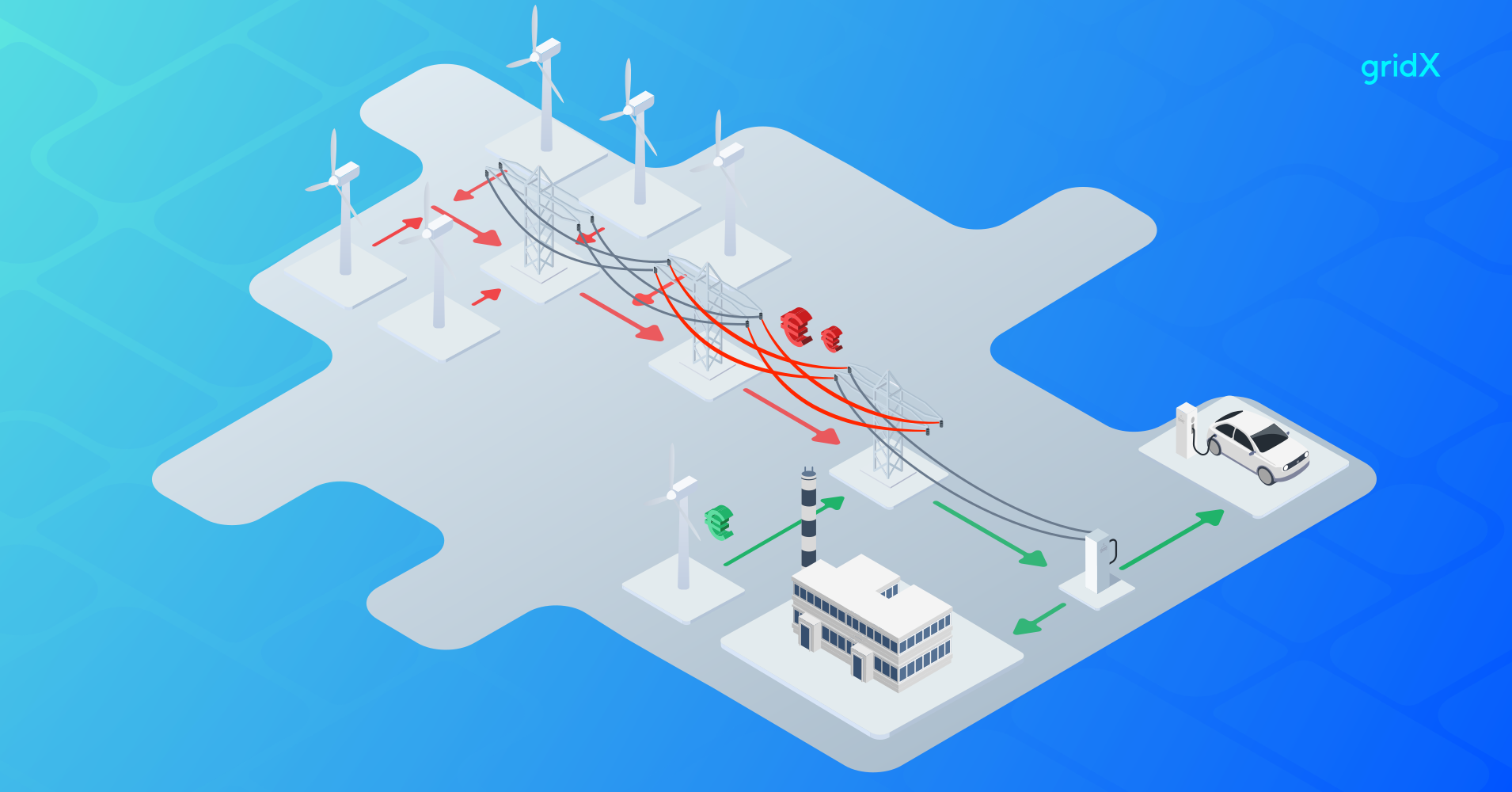
AgNes is a formal regulatory proceeding (Festlegungsverfahren) by the BNetzA that redesigns how electricity grid costs are allocated and recovered in Germany. The core shift: grid tariffs will no longer only recover infrastructure costs but also send price signals that incentivize grid-friendly behavior for both consumers AND generators.
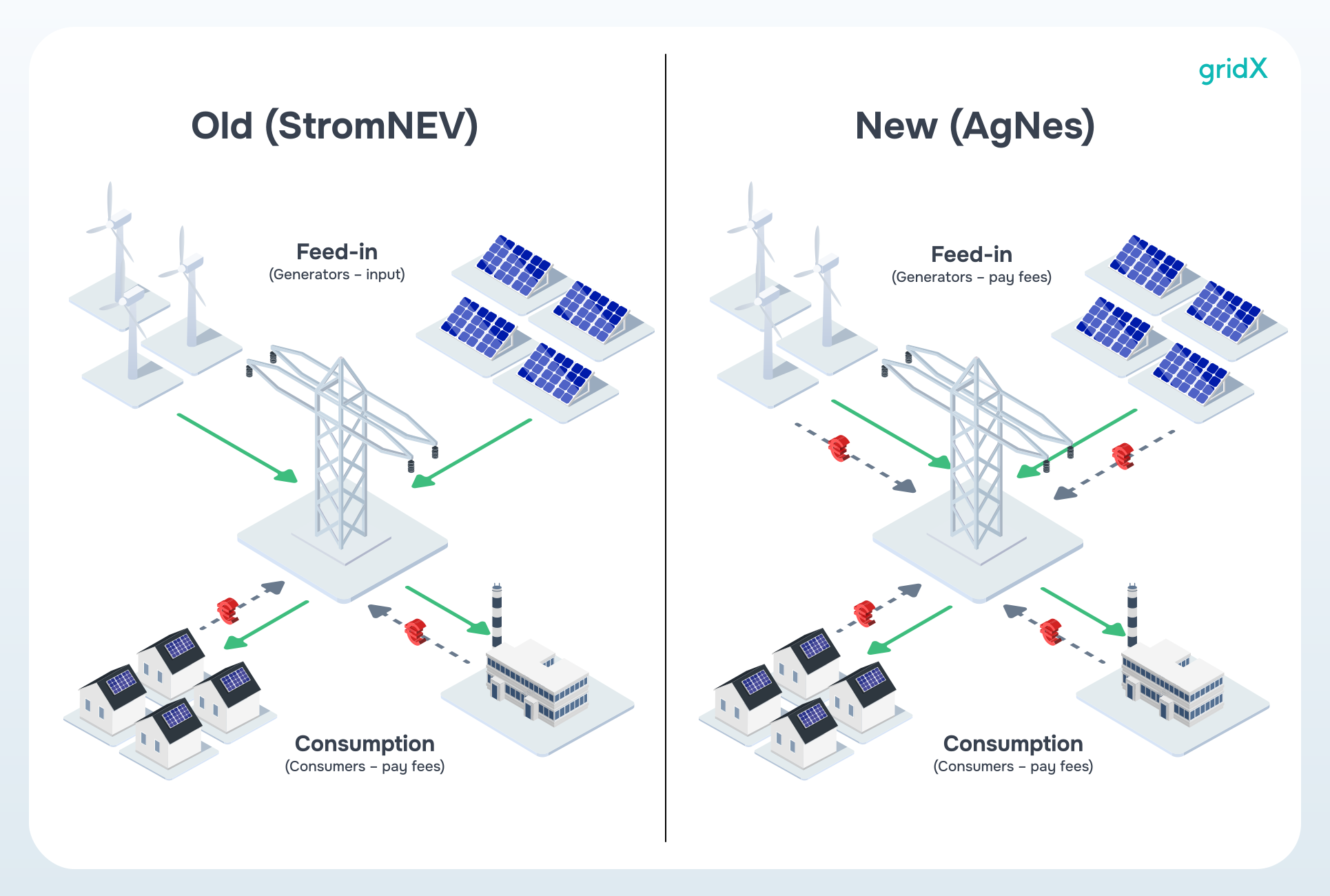
Under the current system (§ 15 StromNEV), feed-in generators do not have to pay grid fees. The BNetzA published an orientation paper on feed-in tariffs in February 2026, outlining three instruments it intends to introduce with AgNes: a capacity charge (financing function), a dynamic energy-based charge (incentive function) and a one-off construction cost contribution for every new grid connection.
The logic is that both generation and consumption drive grid costs, requiring generators to share cost recovery with the goal of broadening the financing base. This is supposed to reduce the burden on consumers.
Why AgNes matters (in theory)
Germany's electricity grid is undergoing a structural transformation. Renewable generation capacity has grown to over 210 GW in 2025 The system is shifting from a centralized, demand-following generation to a decentralized and weather-dependent supply pattern. This creates two problems.
First, the cost of maintaining and expanding the grid is rising. Grid congestion management alone cost roughly €2.9 billion in 2024. That was driven primarily by north-south transmission bottlenecks with high renewable energy production in the north and high consumption in the south driving congestion. Under the old system, all of these costs were shouldered by consumers. Generators, the primary drivers of congestion, paid nothing. This became increasingly problematic as renewables expanded the share of uncontrollable, weather-dependent generation in the system.
Second, the financing base for grid costs is eroding. As more consumers install their own generation (rooftop PV, batteries, EVs), they reduce their own grid consumption and therefore their share of grid cost recovery. At the same time, utility-scale wind and solar plants increasingly trigger congestion and receive redispatch compensation under §13a EnWG –costs that are socialized across all remaining grid users. Those without the means to invest in distributed energy resources end up bearing a disproportionate share. The EE-Mehrkostenausgleich, in effect since 2025, redistributes these burdens across grid regions, but it only shifts costs between consumer groups. It does not broaden the financing base to include generators.
With AgNes, this is supposed to change by requiring generators to contribute to grid financing and to respond to price signals that reflect real-time grid conditions. The BNetzA's stated goal is a tariff system with two functions: reliable cost recovery (financing) and incentive towards grid-friendly behavior (incentives).
This is one of the most fundamental reforms of German grid tariff regulation in decades. It affects investment decisions for new generation assets, the economics of existing renewable plants and the role of flexibility technologies like storage, V2G and smart energy management systems.
Which instruments will AgNes use?
The planned framework for feed-in generators rests on three instruments, each serving a distinct purpose. The BNetzA deliberately separates financing instruments (stable cost recovery) from incentive instruments (behavioral steering), though it acknowledges overlaps between them.
Instrument 1: Capacity charge
The capacity charge is the primary financing instrument. Generators pay a fee for their grid connection capacity instead of their feed in volume. That way grid operators generate predictable revenue, regardless of weather conditions.
The BNetzA's calculation example yields a range of €4–7/kW per year, depending on whether only TSO-level costs or also DSO-level loss energy costs are included.
The underlying cost base includes the EU-mandated ceiling of €0.50/MWh on the transmission level, plus half of the TSOs' balancing energy and loss energy costs. The BNetzA has decided against full allocation of these costs to generators.
The BNetzA does not pursue energy-based financing charges (ct/kWh). The reasoning: such charges would be passed through to the wholesale market, raising electricity prices for all consumers. They would also distort the merit order and disadvantage the German generation relative to foreign competitors that pay no or lower feed-in tariffs.
A de minimis threshold is under consideration for generators without smart metering obligations.
Instrument 2: Incentive function
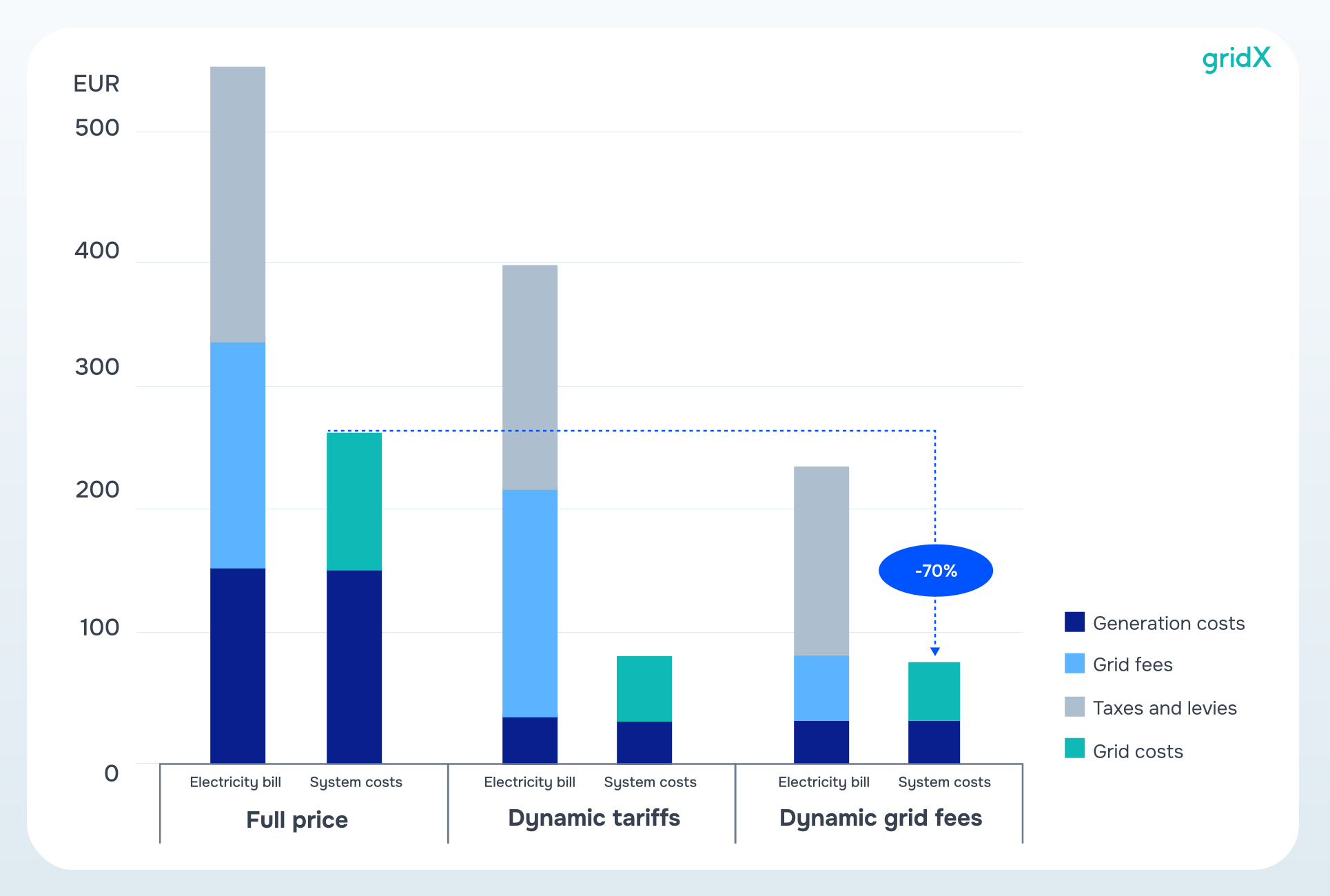
Dynamic grid tariffs are the incentive instrument. They are time-varying, location-specific and energy-based (ct/kWh). Their goal is to internalize congestion management costs into generators' dispatch and investment decisions.
When the grid is congested in any given area, every additional kWh of feed-in exacerbates the problem. The dynamic tariff charges generators for feeding in during congestion. If the generator curtails instead, it avoids the charge but also loses its market revenue. The charge is calibrated so that the economically efficient response is for enough generation to curtail to resolve the congestion, eliminating the need for costly redispatch.
The inverse also holds true: a generator located behind a congestion point with high local demand receives a negative tariff or pays a very small tariff when feeding in. In practice, we can’t expect any meaningful magnitude of negative tariffs in the introductory phase.
The BNetzA's calculation example derives an average dynamic tariff of approximately €0.10/kWh. For context, this is roughly a quarter of the average German household electricity price (~37 ct/kWh in 2026) and around 60% of the average price paid by small and medium-sized industrial customers (~16 ct/kWh).
For the introductory phase, the BNetzA plans to start with a lower tariff and gradually increase it as empirical data on generator price sensitivity becomes available. The explicit goal in the initial phase is not full congestion relief, but learning how generators respond to price signals.
Publication is planned on a day-ahead basis, before the closure of spot markets, so that market participants can incorporate the price signals into their bidding strategies.
This mechanism is highly contested by the industry.
Instrument 3: Construction cost contributions
The BKZ is a one-off payment mandatory for every new grid connection. It is linked to the requested connection capacity so as to address the immediate grid reinforcement costs caused by a new connection.
Its planned function is capacity discipline: by pricing the grid connection, the BKZ incentivizes generators to request only the capacity they actually need.
A project developer who sizes a solar farm's grid connection at 15 MW instead of 20 MW (accepting occasional curtailment at peak output) pays less and reduces the grid reinforcement required.
BKZ also has a financing function, though it is a one-off contribution rather than a recurring revenue stream. It should reduce the grid costs that must be recovered through general grid tariffs.
Flexible connection agreements (FCAs), where generators accept curtailment during congestion in exchange for a cheaper or faster grid connection, can influence the BKZ assessment.
The BKZ applies only to new connections. Existing assets will not be affected.
How AgNes would affect feed-in generators
The impact of AgNes varies significantly depending on the type, location and age of a generation asset.
Renewable energy assets (wind, PV or solar, biogas)
Renewables are the most affected group. Wind and solar plants have near-zero marginal costs, which creates a specific problem with dynamic tariffs: when the tariff exceeds the market revenue in a given quarter-hour, all plants in the area face the same incentive to stop dispatch simultaneously.
This ‘overreaction’ risk is explicitly acknowledged by the BNetzA. The BNetzA argues that differences in auction-based feed-in premiums (anzulegende Werte), operational constraints (e.g. biogas plants needing heat output), and the gradual introduction with low initial tariffs will mitigate this risk.
Conventional and residual-load power plants
They face capacity charges that increase their fixed costs. For peaking plants with low utilization hours, a €4–7/kW charge could affect profitability.
The BNetzA also acknowledges the risk of negative impacts on investment in dispatchable capacity, which Germany needs for grid stability. The dynamic tariffs are less problematic for conventional plants, since their heterogeneous marginal costs make a synchronized overreaction unlikely.
Consumers
Consumers do not pay feed-in tariffs directly but are affected indirectly. The BNetzA expects limited consumer relief from the financing function: capacity charges probably won’t be passed through to wholesale prices in the short term but will be reflected in higher auction bids and capacity market prices over time.
The decision against energy-based financing charges was explicitly driven by concerns about disproportionate impacts on energy-intensive industry, which already pays reduced grid fees under existing exemption rules.
Grid operators
Grid operators gain a new, predictable revenue stream from capacity charges and a one-off financing contribution from BKZ payments.
However, they also face significant complexity: dynamic tariffs require daily congestion forecasting and quarter-hourly price publication on a day-ahead basis. The BNetzA plans a phased rollout, starting at transmission and high-voltage levels and extending downward over time. Medium-voltage generators (where most utility-scale wind and solar parks sit) would be addressed where their feed-in influences congestion above them, with low voltage following later given the much larger number of users involved.
Project developers and investors
Project developers and investors face a complex investment landscape. The combination of location-specific dynamic tariffs, capacity charges, and BKZ payments adds new variables to project economics. Sites in chronic congestion areas (typically northern Germany) become less attractive; sites behind congestion points (typically southern Germany) gain a comparative advantage.
Legacy protection for existing assets
The BNetzA draws a clear distinction between the two tariff types.
For the capacity charge (financing function), the BNetzA is planning to grant legacy protection to assets that were built on the basis of a government-organized auction process. The reasoning: when a developer submitted an auction bid, the bid reflected the assumption of no grid fees for generators. Retrospectively imposing a fixed charge would change the economic basis of their commitment.
The cut-off date for legacy protection is still open as of writing (May 2026). The BNetzA considers three options: publication of the February 2026 orientation paper, publication of a draft decision, or publication of the final binding decision.
For the dynamic tariff (incentive function), legacy protection is not considered. The BNetzA's puts forth three arguments: dynamic tariffs only apply during congestion events (temporary limitation), the tariffs are avoidable through grid friendly behavior (the generator can curtail), and they could even generate positive revenue (behind congestion points).
Additionally, the BNetzA makes a grid security argument: as generation capacity grows relative to load, the operational complexity of managing congestion is approaching the limits of what grid operators are able to handle.
What this means for energy management
AgNes fundamentally changes the operating environment for generation assets connected to the German grid. For energy management systems (EMS) and flexibility platforms, three implications stand out.
Dynamic tariffs create a new optimization layer
Generation assets – particularly those with some dispatch flexibility – such as biogas plants, battery storage co-located with renewables, or V2G-capable EV fleets, will need to incorporate quarter-hourly, location-specific grid tariff signals into their dispatch logic. This goes beyond today's optimization against wholesale market prices and feed-in premiums. An EMS that can process these different cost/price signals and adjust generation or storage behavior accordingly will directly reduce grid fee exposure and capture revenue from sign-correct operation. Prosumer households as last in line will eventually be affected as well.
The BKZ incentivizes flexible connection agreements
By pricing grid connection capacity, the BKZ creates a direct financial incentive for generators to accept flexible connections where the grid operator can curtail feed-in during congestion in exchange for a lower connection cost. EMS platforms that can manage curtailment dynamically, ensuring compliance while maximizing revenue from available capacity, become a critical enabler.
Capacity charges favour efficient system design
Since the charge is based on contractually agreed connection capacity, oversizing grid connections becomes costly. This incentivizes tighter integration of generation, storage and flexible loads behind the meter –exactly the kind of system-level optimization that platforms like gridX's XENON enable. A solar farm with co-located battery storage and intelligent feed-in management can request a smaller grid connection, pay a lower capacity charge, and still maximize energy yield through storage shifting.
The convergence of dynamic grid tariffs, wholesale market prices and feed-in premiums creates a multi-signal optimization problem that manual management cannot solve. Automated energy management becomes not just an operational convenience but an economic necessity.
Industry criticism
The BNetzA's dynamic tariff proposal has faced substantial pushback from the energy industry. The BDEW's formal position paper of 27 February 2026 rejects the model outright, arguing that while the BNetzA's goal of reducing redispatch and grid expansion costs is correct and ambitious, the proposed instrument cannot achieve it.
The BDEW's critique rests on several pillars.
Congestion cannot be forecast accurately enough
The dynamic tariff is supposed to be published before day-ahead market closure. But congestion on the transmission level shows no clear recurring patterns and is driven by the interaction of fluctuating renewable generation, European market coupling, and cross-border power flows. Even small deviations in forecast timing can lead to large gaps. A tariff based on inaccurate forecasts risks creating perverse incentives, potentially increasing rather than reducing congestion.
Operational implementation is unrealistic
The BDEW argues that mass-market scalability, standardization and clear billing roles are necessary for any variable tariff component. The proposed system would require every grid operator to publish location-specific, quarter-hourly prices for each voltage level on a daily basis. This creates massive complexity for grid operators, suppliers, and customers alike. The BDEW points to previous regulatory implementations, such as the 24-hour supplier switching process and §14a EnWG Module 3, as cautionary examples of how complex processes fail without these prerequisites.
Revenue stability for grid operators is at risk
The symmetric design of dynamic tariffs (positive charges during congestion, negative charges behind congestion) combined with varying price elasticities across customer groups will likely create significant revenue volatility for distribution system operators (DSOs). The BNetzA has not clarified how over- and under-recoveries would be handled. The BDEW insists that DSOs must be held neutral from revenue effects caused by TSO-level price signals they cannot influence.
Feed-in tariffs distort cross-border competition
If German wind farms in congestion areas face a temporary feed-in charge, they become more expensive in the merit order than comparable wind farms across the border in the Netherlands, which pay no such charge. Foreign generators could then feed into the German transmission grid across the congestion point, negating the intended congestion relief while displacing domestic production. This would also reduce the full-load hours of German installations and increase the per-kWh subsidy cost from the federal budget.
Investment uncertainty rises across the board
Dynamic feed-in tariffs represent an unhedgeable cost because unlike fuel or emission costs, they cannot be secured on forward markets. This creates a new financing risk that would be priced into project financing as a risk premium, raising the cost of capital for renewable energy, storage, and conventional power plants alike. The BDEW warns that in the worst case, banks may refuse to lend or demand significantly higher equity ratios because project returns can no longer be reliably forecast. This directly conflicts with the government's power plant strategy (Kraftwerksstrategie), which plans capacity auctions for late 2026 bidders cannot submit offers if they cannot calculate their future cost base.
The BDEW proposes an alternative
Rather than fully dynamic tariffs, the BDEW advocates for a capacity price model developed jointly with EWI (Institute of Energy Economics at the University of Cologne). This model offers a discounted optional capacity that the grid operator can curtail during periods of high grid stress. The time windows for curtailment would initially be set semi-annually or quarterly with long lead times, with granularity increasing gradually as the system matures. This approach can address predictable congestion patterns such as high PV feed-in at midday in summer or peak loads in winter, without the complexity and risks of real-time dynamic pricing. The BDEW acknowledges that this approach only enables coarse load and capacity management, but argues that the volatile, short-term redispatch problem cannot be solved by any tariff instrument whether static-variable or fully dynamic.
Expert insights and outlook
As Carsten Schäfer, Senior Strategic Manager Regulation and Innovation at gridX, puts it: "The existing grid tariff structures are a deeply inflexible construct. They are one-sided and built for a different era. The fundamental idea of rethinking them is absolutely right. We need to stop thinking only for the next five years and start designing for an all-electric society."
Carsten is supportive of the broader direction AgNes is taking but sees important nuances across the three proposed instruments.
On the construction cost contribution (BKZ), he is sceptical, not of cost-sharing in principle, but of the instrument's design philosophy: "German energy regulation has always treated feed-in and consumption as separate worlds. The BKZ reinforces that separation. What we actually need is a framework that treats prosumers as the default. One capacity, one connection, both directions. The exception should be the pure consumer without generation, not the other way around."
On dynamic grid tariffs, Carsten takes a pragmatic view and pushes back on inflated criticism: "There's a lot of position-taking in this debate. Yes, there are real concerns about forecast accuracy and overreaction of generators. But look at the UK for example. They use a simple randomized delay to desynchronize responses and prevent simultaneous switching. You don't need a complex mechanism to solve many of the challenges." He considers the BNetzA's day-ahead approach a reasonable starting point: "Starting with day-ahead is more realistic than jumping straight to intraday pricing. And fixed time windows, like what §14a already enables, should be the absolute minimum outcome of this process."
On the 2029 timeline, Carsten is cautiously realistic: "Technically, we at gridX can already handle dynamic grid tariffs in combination with other price and cost signals. It's the same technical logic as dynamic energy prices – just in the other direction."
The broader industry moves more slowly. He adds, "Many grid operators and metering point operators still can't fully process dynamic energy tariffs. A lot of system and solution providers still can't do it. So the rollout will likely cascade from high voltage down to low voltage, with longer transition phases. I don’t think that 2029 is a realistic timeline for the entire grid."
Looking ahead, Carsten emphasizes that the regulatory design must account for the long-term goal of electrification: "Renewables are the cheapest energy source. Electrification won't be reversed. Whatever framework comes out of AgNes needs to enable the energy transition and sustainability, not slow them down because of short-term thinking and restrictive positions."