What is EMS retrofitting?
EMS retrofitting is the process of connecting existing energy assets — like photovoltaics (PV), batteries, EV chargers or heat pumps — to an energy management system (EMS) so they can be monitored, controlled and optimized as one smart system. Instead of replacing hardware, EMS retrofitting adds the digital layer that older installations are missing. With plug-and-play energy solutions, this can often be done without rewiring or rebuilding, turning passive assets into intelligent, coordinated ones.
Where energy efficiency retrofitting fits in
Energy efficiency retrofitting focuses on upgrading buildings or infrastructures to reduce consumption and improve performance. EMS retrofitting is the most scalable way to achieve this because it digitalizes what already exists. It doesn’t just swap old equipment for new, it makes the whole system data-driven and automated. Whether it’s solar retrofitting, charger retrofitting or heat pump integration, the value comes from connecting the assets, not reinstalling them.
Why EMS retrofitting matters in Europe
Across markets like Germany, the Netherlands and the UK, millions of PV systems, wallboxes and heat pumps are already installed but still run offline. EMS retrofitting unlocks flexibility, self-consumption and cost savings without touching the hardware itself. It is how Europe upgrades at scale: not by replacing functioning systems, but by making them smart.
How gridX defines EMS retrofitting

At gridX, EMS retrofitting means connecting an existing energy asset to the gridX EMS for the first time. This happens in two ways:
- Retro-connect
Existing assets are linked to the EMS without adding new hardware – for example, connecting a PV system, EV charger or heat pump via a local gateway or cloud-to-cloud integration. This enables smart control, dynamic tariff optimization and compliance with regulations such as §14a EnWG and §9 EEG. - Retro-expand
Existing assets are connected to the EMS while new components are added at the same time – for instance, integrating a battery or heat pump with an existing PV setup. Connection can be achieved through a local gateway or cloud-to-cloud setup, creating a fully optimized, flexible and grid-ready energy system.
Both approaches represent the foundation of energy digitalization – using data, connectivity and automation to elevate yesterday’s installations to today’s smart energy standards. With plug-and-play energy solutions reducing complexity and cost, retrofitting is how Europe can accelerate its energy transition – not by rebuilding from scratch, but by making what already exists intelligent and interconnected.
Why retrofitting matters for the energy transition
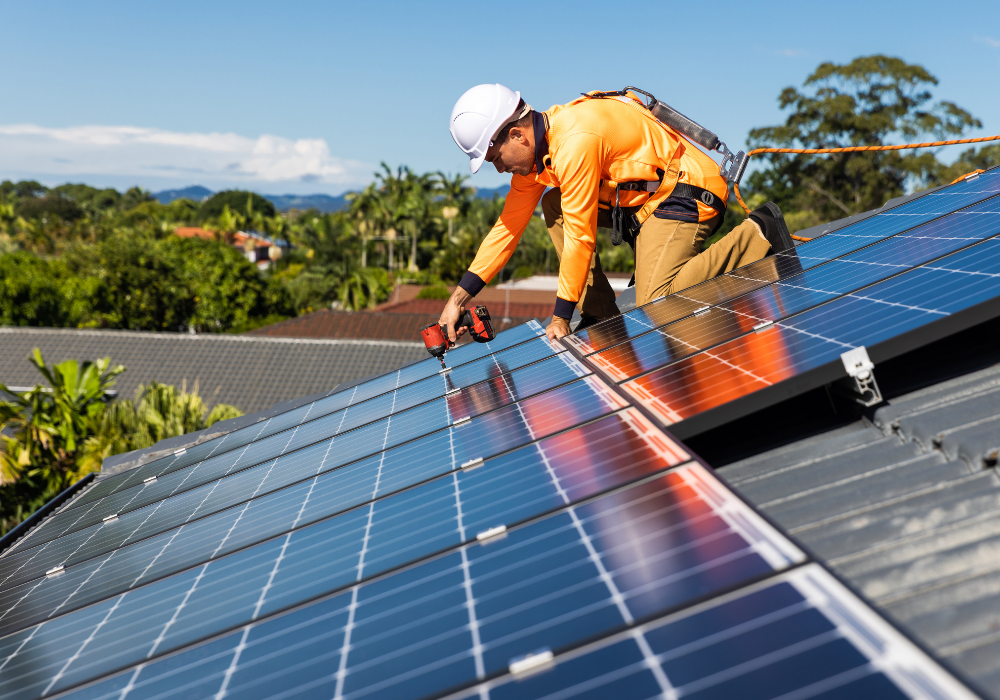
Retrofitting is vital for Europe’s decarbonization goals. Most buildings were never designed for solar panels, heat pumps or batteries, yet these technologies now anchor the energy transition. Upgrading or connecting existing assets to smart controls delivers major efficiency gains. Studies show that combining solar retrofitting with measures like insulation and automation can cut grid energy use by up to 88%.
Turning homes into active energy players with solar retrofitting
By adding battery storage or energy management to existing PV systems, solar retrofitting boosts self-consumption and heavily reduces energy costs. Homes can store excess power, shift usage to off-peak times and even sell flexibility back to the grid when it is needed most. This turns households from passive consumers into active participants in the energy system and ensures that power harnessed from the sun doesn’t go to waste.
Broader gains for the entire energy ecosystem
The impact extends beyond homeowners. Manufacturers retain customer loyalty by keeping legacy systems compatible with new tech. Installers and wholesalers unlock new business through retrofit upgrades. And for grid operators, connected assets like batteries and heat pumps become controllable tools to balance supply and demand, driving Europe closer to energy independence.
Retrofitting markets across Europe
.png)
Across Europe, millions of PV systems, heat pumps and wallboxes are already in place, but most are still disconnected and unmanaged. That is the real retrofit opportunity. Not installing more hardware, but bringing existing assets online and making them smart.
Germany
Germany is the single largest retrofit market in Europe because most of its energy assets already exist – but many are not yet digitally connected.
PV
Germany has around ~100–112 GW of installed solar PV, and roughly 70 % of it is on rooftops, which means about 70–78 GW is distributed across homes and small buildings. Most of these systems were installed without batteries or an energy management system (EMS), so they can only feed power into the grid or be used immediately on-site. They can’t store excess energy, shift consumption, or react to tariffs or grid signals.
This is why solar retrofitting is such a massive opportunity in Germany: the panels are already there, but the value isn’t. By adding batteries and EMS connectivity, millions of static PV systems can be turned into flexible, self-consuming, grid-interactive assets without replacing a single module.
Wallboxes
Germany has more than 1 million private wallboxes installed, but most of them operate as standalone devices — not connected to PV, a battery or an EMS. That means they simply charge at whatever price the grid offers, instead of reacting to cheap solar power or dynamic tariffs.
EVs are huge electrical loads but also highly flexible assets, sitting parked and unused around 95 % of the time. Retrofitting these chargers with PV integration and EMS control turns them from cost drivers into controllable storage on wheels, cutting household energy costs and stabilizing the grid at the same time.
Heat pump
~2.2 million heat pumps installed, but ~800,000 (36%) are unoptimized with no EMS, PV or battery pairing. Huge opportunity to turn “dumb” electrified heating into flexible cost-efficient loads.
Netherlands
The Netherlands has one of the densest rooftop PV and heat pump installations in Europe, but because net-metering, which will phase out by 2026, delayed battery adoption and EMS integration, most systems run “as installed.” Not smart, not optimized. That makes the country a retrofit market by design: the hardware is there, the intelligence isn’t. Not yet.
PV
The Netherlands has ~70–75 % rooftop PV, roughly 17 to 18 GW. Most of these systems were installed without batteries because net-metering removed the financial need for storage. As the policy is phased out, this entire rooftop base becomes a direct target for solar retrofitting with batteries and EMS.
Wallboxes
There are an estimated ~100–200k private chargers. Most of them are not connected to PV, a battery or any load control. As more Dutch households install home charging, the retrofit value shifts from public charging to smart residential charging.
Heat pump
The Netherlands has ~2.6 million heat pumps, one of the highest per-capita numbers in Europe. Many are simple air-to-air units with no digital control, which means retrofitting often requires software integration, not hardware swap.
United Kingdom
Around 3.2 million UK households already have at least one electrified asset, but most of them still operate as standalone systems. With ~7 GW of rooftop PV, roughly 250–300 k private home chargers and around 450 k heat pumps in place, the UK’s transition challenge isn’t installation, it’s integration. The real market is upgrading these existing assets with storage, automation and EMS control so they finally work together instead of in isolation.
PV
The UK has about ~22 GW total PV, but only around 7 GW is on rooftops. Most of those rooftop systems were installed without batteries or EMS, so they export instead of storing or coordinating load.
Wallboxes
There are ~250–300 k private home chargers in the UK. Home charging is the norm, but almost no wallboxes are linked to PV production or household energy control.
Heat pump
~0.4–0.45 million heat pumps installed – early stage, but growing fast. Almost all are not part of a connected energy system, making the UK a retrofit-first rather than new-build-first market.
How to retrofit an energy system: from retro-connect to retro-expand
Retrofitting an energy system can take different forms depending on the starting point.
Retro-connect: Making existing systems smart
In this case, an existing asset or multiple assets – like solar panels, EV chargers or heat pumps – that a customer already owns are connected to a new energy management system without adding new hardware. For example, imagine a household that installed rooftop solar panels a few years ago – they have a PV inverter feeding the home and grid, but no smart controls or battery.
Through a retro-connect, the homeowner can install a local gateway – such as a HEMS device like gridX’s gridBox – that communicates with the existing inverter and electricity meter. The gateway collects local energy data and sends it securely to the cloud-based EMS, where it is analyzed and optimized in real time. This setup enables advanced functions such as dynamic tariff optimization and compliance with regulations like §14a EnWG and §9 EEG, resulting in lower energy costs for the user and a grid-friendly, controllable asset for the system operator.
Importantly, no new generation or storage hardware is added; we’re just making an old system intelligent. In practice, a technician or even the end-customer (if it’s simple enough) sets up the control box and links it to the PV inverter’s data feed or control interface.
Many modern inverters have built-in communication modules, so a retro-connect often involves ensuring compatibility between the inverter’s protocol and the EMS. If the inverter is an older model lacking smart interfaces, a retrofit might require adding a sensor or smart meter gateway – for instance, an energy meter that measures the PV output and feeds data to the EMS, effectively “digitizing” the system’s behavior.
Retro-connect in the context of heat pumps could mean connecting an existing heat pump that was previously running in silos into a new smart control platform – for example, linking it with a demand response service or home EMS where none existed before.
Retro-expand: adding new assets for greater efficiency

A more involved scenario is retro-expand, where we not only connect existing assets but also install new ones alongside them. This often happens when homeowners decide to upscale their clean energy setup – say by adding a battery to an existing solar PV system (a common retrofit in solar-heavy markets), or by installing a heat pump in a home that already has solar panels. In a retro-expand project, the installer will typically integrate the new hardware so it works in concert with the old. For example, consider a household in Germany that has been running a 11.5 kW PV array for years and now opts to add a home battery. The retrofit involves physical installation of the battery unit and perhaps a hybrid inverter or separate battery inverter. The existing PV system is connected to the new setup so that the battery can charge from the panels.
At the same time, a home energy management system (HEMS) is deployed to coordinate when the battery charges or discharges, when to export to the grid, etc., using inputs from both the old PV inverter and the new battery’s management system. If the household switches from a static to a dynamic tariff, the HEMS can charge the battery according to real-time prices to further reduce costs. This is a retro-expand in action – we’ve expanded the capabilities of the original system (PV-only) by adding hardware (storage) and tying it all together under unified control. This retro-upgrade could save a German household almost €400 per year.
In the Netherlands and the UK, many households are moving from gas boilers to electric heat pumps. A typical retro-expand starts with installing a heat pump alongside the boiler, then later adding HEMS, solar PV and a battery to create a fully optimized setup. With HEMS in place, the heat pump can automatically run when solar production is high, using excess electricity to store heat in water or thermal mass instead of sending it to the grid. This turns a simple boiler swap into a smart, future-proof energy system
The real savings appear for households that already have energy-consuming assets, a heat pump or a wallbox, and then retro-expand to add solar, a battery and a HEMS. An average household starting with a heat pump could save around €2,500 with the new setup, and households starting with an electric car and charger save around €2,000.
Making retrofitting scalable: challenges and keys to success
.png)
Retrofitting millions of existing energy systems is a very different challenge from equipping new buildings. By nature, retrofits must contend with legacy issues – physical constraints of older buildings, heterogeneous equipment and consumer habits formed in a different energy era. Technical feasibility is largely in hand: today’s EMS and IoT technologies can interface with most solar inverters and heat pumps, and installers have developed standard methods to add batteries or other components to existing setups. Achieving alignment means:
Timing
Retrofitting happens fastest when there is a natural trigger. Most homeowners only upgrade when something forces a decision: an inverter reaches end of life, a feed-in tariff expires or a renovation is already underway. In Europe, regulation is now creating those trigger points. In the UK, G100 export and import limits are pushing PV owners to add batteries instead of curtailing output. In the Netherlands, the phase-out of net metering makes self-consumption far more valuable, turning retro-connect and retro-expand into financial no-brainers. In Germany, §14a EnWG and §9 EEG reward controllable, grid-friendly assets, meaning heat pumps and PV systems without smart control will soon lose out.
At grid level, timing matters too – it is cheaper to retrofit before a local transformer reaches its limit than to reinforce the grid after failure. The combination of regulation, lifecycle events and rising energy costs is making “later” no longer an option.
Compatibility
One of the biggest barriers to retrofitting at scale is getting old and new systems to communicate. Every inverter, heat pump or charger speaks its own “language,” and most were never designed to work in a unified setup. This leads to fragmented apps, limited control and costly custom integrations.
The fastest path forward is interoperability by design. Instead of relying on universal standards that rarely materialize, platforms like gridX solve compatibility by supporting a wide range of communication protocols and devices out of the box and building direct integrations with original equipment manufacturers (OEMs). This removes complexity for installers and prevents homeowners from ending up with three systems and three apps, which in the end do not work well together.
There will always be legacy edge cases – an inverter with no API or a heat pump from a discontinued brand. That is where retrofit add-ons, sensors or control kits bridge the gap. But the long-term goal is clear: retrofitting should feel like plug in, connect, done. A single EMS dashboard, not a stack of apps, is what makes retro-connect and retro-expand scalable.
Simplified commissioning
Scalability also depends on how fast, error-free and repeatable commissioning can be. This is where plug and play via Ready for gridX becomes a decisive advantage. Ready for gridX is our integration program that enables OEM partners to bake EMS compatibility directly into their hardware. The result: zero custom setup, no protocol troubleshooting and commissioning that takes minutes, not hours.
Closer partnerships with OEMs are the only way to make plug and play energy solutions the default rather than the exception. If an inverter, heat pump or battery comes “Ready for gridX,” it connects to the EMS the moment it is powered on – no extra hardware, no manual pairing, no guesswork for installers. This level of pre-integration is what turns retrofitting from a one-off engineering task into a repeatable product.
Incentives
Financial and policy incentives ultimately drive the adoption at scale. Retrofits often have an upfront cost that homeowners might not be prepared for, especially if the existing system “works fine.” Regulatory mandates can also be a form of incentive via requirement – the Netherlands’ mandate on hybrids and the UK’s Future Homes Standard effectively force modernization. Another angle is energy market incentives: making sure that if someone retrofits with, say, a battery, they can earn extra savings by enrolling in a tariff or grid service.
For example, if dynamic tariffs or capacity-based network charges are in place, a smart retrofit immediately has a clear payback by avoiding high-cost periods. Policymakers should ensure that market signals reward flexibility at the residential level. The forthcoming EU policies (like updated building directives and the Emissions Trading System extension to buildings) are expected to bolster the business case for home retrofits by penalizing inefficiency and rewarding low-carbon tech.
Consumer awareness and trust
Finally, an often underappreciated factor in scaling retrofits is consumer awareness and trust. Home energy retrofits can be complex and intimidating for the average person. Transparent information, reputable installers, and perhaps one-stop-shop services make a huge difference.
Initiatives like “energy cafes” or municipal advice centers in Germany, or the Solar Together group-buying scheme in the UK, help demystify the process. A clear message that retrofitting (connecting that existing PV via a retro-connect or upselling to a retro-expand package) is easy and beneficial will increase uptake. Governments and companies need to highlight success stories and ensure quality control to avoid horror stories that could sour public opinion.
Expert insights on retrofitting
Carsten Schäfer, Senior Product Manager Innovation at gridX, emphasizes that the key to scaling energy efficiency retrofitting lies in technology – specifically, how it enables connection, communication and control across diverse energy assets. “Technology is the accelerator,” he explains. “The more seamlessly we can connect existing assets and expand them intelligently, the faster we move toward a fully digitalized energy landscape.”
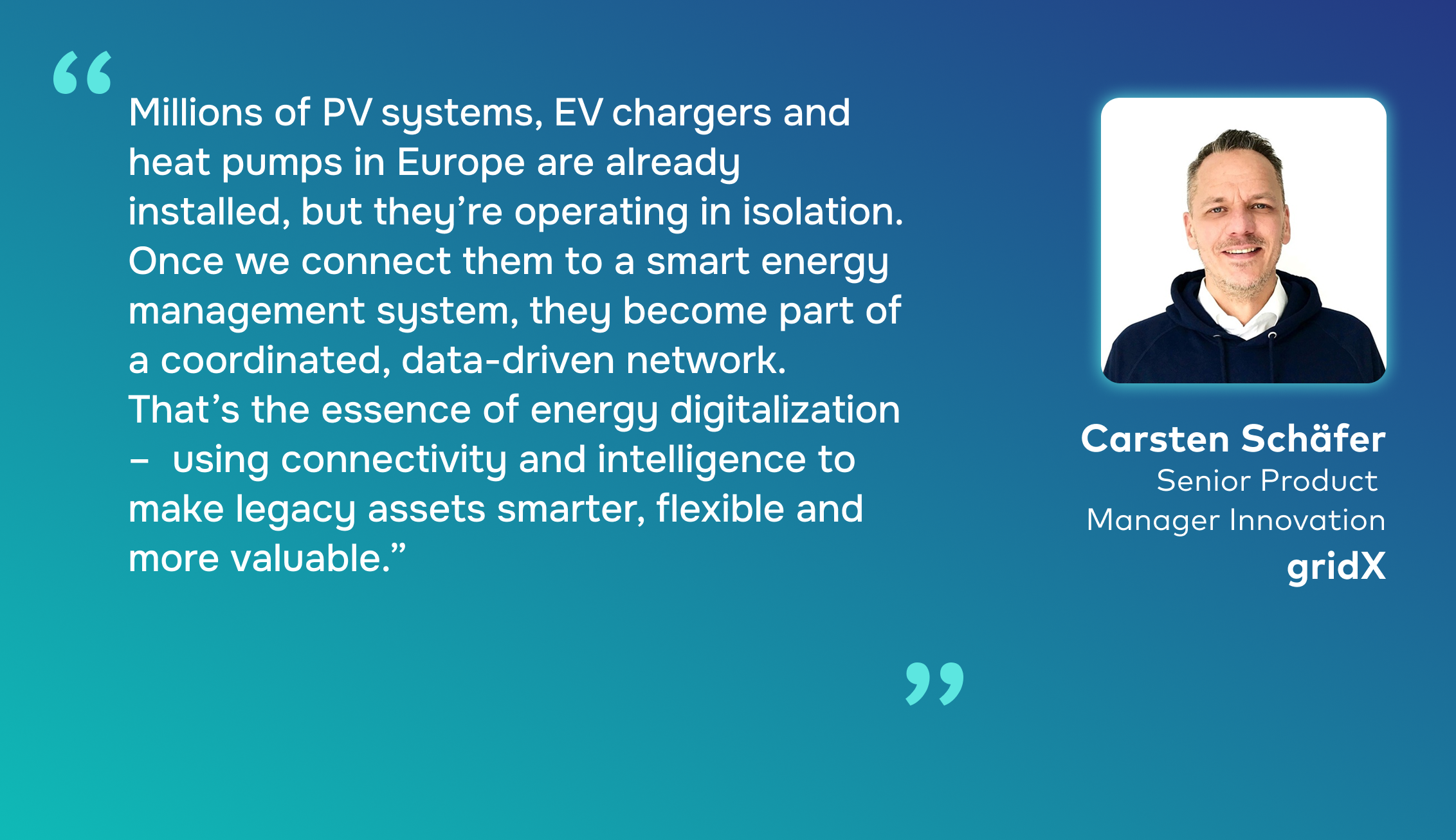
Carsten sees retro-connect and retro-expand as two sides of the same innovation curve. “Retro-connect is about giving existing systems a digital heartbeat,” he says. “Millions of PV systems, EV chargers and heat pumps in Europe are already installed, but they’re operating in isolation. Once we connect them to a smart energy management system, they become part of a coordinated, data-driven network. That’s the essence of energy digitalization – using connectivity and intelligence to make legacy assets smarter, flexible and more valuable.”
He adds that retro-expand builds on that foundation, taking digitalization one step further. “When we add new assets like batteries or heat pumps to existing systems, the EMS becomes the brain that makes it all work together. It can forecast generation, shift consumption and even trade energy dynamically,” Carsten explains. “This is where the true potential of distributed energy unfolds when every connected device can react to grid signals or price incentives in real time.”
From gridX’s perspective, the technology stack behind retrofitting – secure connectivity, interoperable APIs,local gateway control in combination with cloud-to-cloud connections – makes all the difference. “Scalable retrofitting isn’t just about adding more devices. It’s about building a unified digital layer that integrates all assets, regardless of manufacturer or age,” Carsten says. “That’s why we’ve focused on providing hardware-agnostic connectivity. Whether it’s a five-year-old inverter or a brand-new battery, we can bring it online within one platform.”
For Carsten, energy management system retrofitting is a fast, simple and smart path to achieving Europe’s energy goals. “We don’t need to rebuild everything from scratch,” he concludes. “We just need to retro-connect what exists today and retro-expand intelligently. Once everything speaks a digital language, the transition to a decentralized, flexible energy system becomes unstoppable.”