
How §19 EEG, MiSpeL and XENON unlock asset value at scale
The financial headache of Germany’s power grid is spreading from the massive high-voltage ‘superhighways’ down into our local neighborhood distribution network. According to the Bundesnetzagentur Monitoring Report 2025, the bill for keeping the lights on reached €2.9 billion in 2024. While that is down from the €3.3 billion peak in 2023, the real problem is where that money is being spent.
Most of this cash goes toward ‘congestion management.’ Think of this as the grid’s ‘traffic control’ system – whenever a power line gets too crowded, operators have to pay certain plants to turn off and others to turn on to prevent a blackout.
While the public debate remains fixed on building massive new transmission towers, the data shows the real ‘choke point’ has moved into the local, lower-voltage grids managed by distribution system operators (DSOs).
The turning point: This isn't just a problem of ‘clogged’ lines; it’s an expensive coordination gap. For the first time, our local grids are filled with decentralized assets that have fundamentally changed how power flows. While photovoltaic (PV) systems flood the grid with green energy, electric vehicles (EVs) and home batteries provide the critical solution: they can charge and discharge back into the grid, acting as shock absorbers that soak up excess power or inject it back during a shortage.
Our local infrastructure wasn't designed to synchronize with these millions of mini-power plants. The challenge today isn't just building more wires, but finally using this bidirectional flexibility to relieve congestion and turn a 'choke point' into a balanced, two-way street.
The results of this mismatch in distribution grids are reaching record levels:
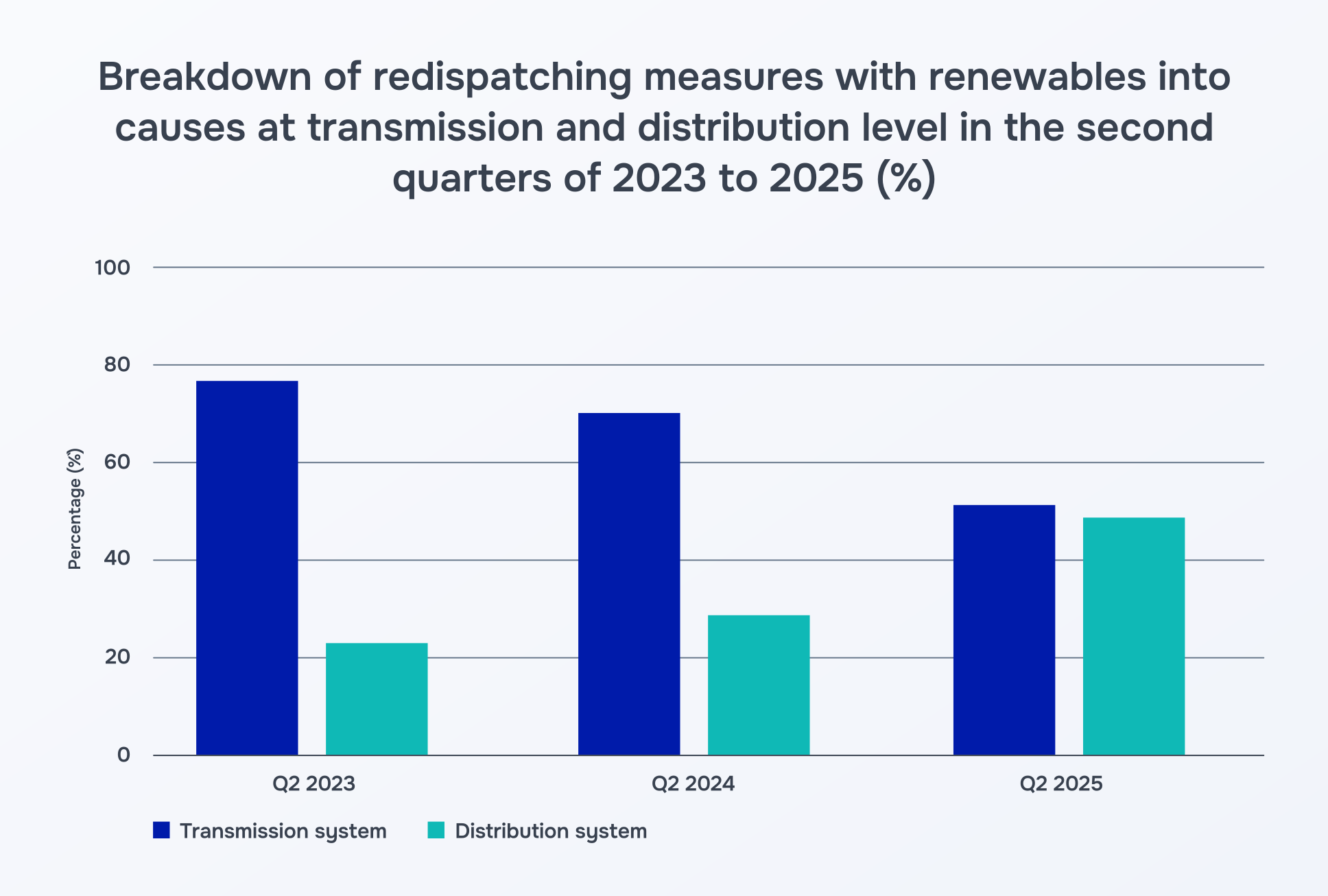
- DSO Pressure: As of the latest 2025 SMARD data, nearly 50% of all renewable energy waste is now caused by bottlenecks in local distribution systems – up from just 26% two years ago.
- The 'Solar Canary': Solar is the ultimate stress signal. Because panels plug into local grids, they are the first to be silenced. In 2025, solar generation surged to a record 74.1 TWh, but redispatch measures involving PV installations nearly doubled in volume compared to the previous year.
Enter MiSpeL: The first real fix for the 'coordination gap'
This is exactly where MiSpeL comes into play. If you aren't familiar with the name, it stands for Marktintegration von Speichern und Ladepunkten (Market Integration of Storage and Charging Points). It is effectively a regulatory 'bridge' under §19 EEG designed to turn energy assets from passive hardware into active, grid-aware participants.
Before MiSpeL, the rules were surprisingly rigid – a 'Dornröschenschlaf' (Sleeping Beauty’s slumber) for local flexibility. If you had a battery paired with solar panels, the end users were often stuck in an 'all or nothing' legal trap:
- The 'green-only' trap: To keep the government subsidies (e.g. the 20-year guaranteed feed-in tariff for German PV systems under the EEG), the battery could only charge from the solar panels, and not charge or discharge from the grid
- The 'grey' penalty: If you charged from the grid (even when it was cheap and green), you risked losing those subsidies or paying double grid fees.
How MiSpeL changes the game
MiSpeL (Market Integration of Storage and Charging Points), which officially transitioned into full process implementation in April 2026, represents the final dismantling of the "siloed' storage era. For utilities and DSOs, it replaces the restrictive 'exclusivity' (Ausschließlichkeitsprinzip) with a dynamic framework designed for high-density, bidirectional grid interaction.
The legacy constraint: §19(3a) EEG
Until April 2026, the EEG framework acted as a structural barrier to local grid stabilization. The legacy 'exclusivity' rule forced a binary operational mode that effectively locked decentralized storage out of the flexibility market:
- Operational rigidity: To protect feed-in subsidies, storage assets were legally restricted to charging exclusively from on-site renewables.
- The contamination risk: Charging from the grid – even during periods of surplus wind generation or negative prices – triggered a 'purity' violation. This led to a total loss of subsidy eligibility for all energy subsequently fed back into the network.
- Grid blindness: For utilities, this created a fleet of millions of batteries that were legally unable to respond to price signals or DSO congestion management commands.
MiSpeL eliminates this conflict. As of April 1st, it provides the legal architecture for storage to be truly 'grid-aware' without financial penalty.
The new operational reality: Bidirectional flexibility
For utilities, MiSpeL provides the legal certainty needed to scale VPP (Virtual Power Plant) and regional arbitrage products:
- Multi-use optimization: Assets can now simultaneously maximize on-site solar consumption while performing grid-level tasks – such as charging during nocturnal wind peaks – without jeopardizing EEG bonuses.
- Partial grid fee relief (Saldierungsfähigkeit): Following the recent EnWG §118(6) reforms, the ‘double-taxation’ of storage is addressed through a net-balancing approach.
The rule: You only pay grid fees for the ‘net consumption,’ which means, the energy that stays in the battery or is lost during the cycle (Round-Trip Efficiency losses).
The benefit: The portion of energy that is purely 'buffered' (drawn from the grid and fed back later) is exempt from grid fees. This Saldierungsfähigkeit is what finally makes bidirectional arbitrage projects bankable, even if it doesn't represent a 100% discount on all throughput.
- Standardized settlement pathways: MiSpeL introduces two distinct models for balancing these 'mixed' energy flows (green solar vs. gray grid power).
- The Abgrenzungsoption (§19(3b) EEG): Designed for C&I (Commercial & Industrial) sites and sophisticated aggregators. This high-precision route relies on a dual-metering configuration:
- Smart meter A captures the pure generation from the renewable asset (the ‘green’ flow).
- Smart meter B (the smart meter gateway) tracks the bidirectional exchange with the public grid (the ‘Mixed’ flow)
- The logic: By cross-referencing these two quarter-hourly (RLM) data streams using standardized mathematical formulas, utilities can 'unmix' the energy. This ensures that only the verifiable green portion receives EEG subsidies, while the remainder is cleared as flexible grid power for market arbitrage.
- The Abgrenzungsoption (§19(3b) EEG): Designed for C&I (Commercial & Industrial) sites and sophisticated aggregators. This high-precision route relies on a dual-metering configuration:
- The Pauschaloption (§19(3c) EEG): This 'lite' version skips the complex metering and instead uses a flat-rate cap – typically 500 kWh per year per kW of solar. Anything under that cap is automatically treated as subsidy-eligible green power, while everything above it is considered flexible market feed-in and thus, not subsidized.
By focusing on these neighborhood-level grids, MiSpeL turns a technical coordination failure into a clear-cut business case. It’s no longer about just 'having' a battery; it’s about finally having the legal permission to use it to its full potential.
How gridX’s white-label EMS platform, XENON, makes MiSpeL operational and profitable
.svg)
While MiSpeL provides the legal 'green light,' the practical reality for a utility is a massive data and hardware puzzle. Managing a fleet of thousands of residential batteries and EVs requires more than just a connection; it requires an intelligence layer capable of navigating the nuances of the Pauschalmodell, while maximizing market revenue.
XENON is designed to act as this intelligence layer, turning the ‘15-minute reality’ of the new energy laws into a scalable revenue stream in three steps:
1. Unified control: Managing the Pauschal portfolio
Residential portfolios are a mosaic of different brands, which poses a significant hurdle for utilities opting for the Pauschalmodell (§19(3c)). The challenge is two-fold: ensuring that every asset – regardless of manufacturer – stays within the legal caps (typically 500 kWh/a per kWp), while remaining available for grid services.
XENON’s local gateway, the gridBox, acts as a universal translator that communicates with over 50 major OEMs out of the box.
As Carsten Schäfer, gridX’s Senior Strategic Manager Innovation, points out, this ability to speak multiple device languages effectively acts as the glue for the entire system. Without this hardware-agnostic foundation, large-scale portfolio integration simply collapses under its own technical complexity, making the administration of subsidy caps across a heterogeneous fleet impossible.”
2: Energy arbitrage: Maximizing the profit spread
The removal of the exclusivity barrier in April 2026 transforms home batteries from static back-up devices into active market participants. Under the Pauschalmodell, utilities can finally engage in energy arbitrage at scale. This allows you to purchase grid power during high-wind nocturnal periods when prices are at their lowest – or even negative – and store it for use or feed-in during peak demand hours.
XENON layers intelligence over the hardware to navigate this daily price volatility. By monitoring real-time market signals alongside the specific subsidy caps of the Pauschalmodell, the system identifies the most profitable windows to charge or discharge. This automated decision-making ensures the utility captures the widest possible profit spread while protecting the end customer’s green subsidies.
3. Vehicle-to-grid (V2G): Turning EVs into mobile grid assets
Beyond stationary storage, MiSpeL provides the legal framework to integrate EVs as dynamic 'grid lungs.' Through V2G technology, a parked plugged-in EV becomes a revenue-generating asset rather than a simple load on the distribution network.
XENON manages this bidirectional flow by balancing the vehicle's state of charge with the needs of the grid. The system ensures the car is ready for the morning commute while utilizing the battery as a 'shock absorber' for the DSO throughout the night. This capability allows utilities to offer new, high-value services where the EV acts as a flexible buffer, injecting power back into the network during local shortages. By automating this bidirectional exchange, utilities can turn a fleet of plugged-in parked cars into a massive, decentralized power plant.
Turning regulatory compliance into a high-yield utility strategy
In this new landscape, settlement – the process of turning 15-minute meter readings into accurate financial transactions – becomes a high-stakes operational hurdle. The utility must prove exactly which kWh were green to secure subsidies for their end customers and which were grey to apply the correct grid fees. If this 'unmixing' data is inaccurate, the utility faces potential financial risk, as profit margins can quickly disappear into balancing energy costs.
XENON automates this entire data value chain, handling the backend complexity to ensure assets remain compliant. As Carsten emphasizes:
“At its core, a white-label EMS is about protecting your business from the chaos of the ‘unmixing’ process. Without automation, you are one data error away from your end customers losing their solar subsidies or your company facing potential penalties for incorrect grid fees. XENON takes that mountain of data and automates the energy flow in the background. It gives your team the confidence to scale a fleet of thousands of active grid participants, knowing that every kilowatt-hour is accounted for and every cent of your margin is safe.”
The German grid is now a two-way street. By addressing the coordination gap at the DSO level through the Pauschalmodell and bidirectional flexibility, utilities can offer products that are green, regulatory-compliant and highly profitable.
XENON automates the translation of complex government regulations into immediate commercial value. This evolution allows utilities to move beyond static portfolio management – the traditional passive approach of maintaining fixed assets with limited real-time responsiveness – and instead manage a high-performance, grid-integrated ecosystem designed to maximize revenue and capture every available market premium.
Frequently asked questions (FAQs) for utilities
1. How does the 'Pauschalmodell' (§19(3c)) actually simplify residential billing?
The 'Pauschalmodell' eliminates the need for expensive, high-precision metering at every residential site. Instead of tracking every single flow, utilities can settle solar subsidies based on a flat cap—typically 500 kWh per kWp of installed capacity annually. This allows you to offer flexible services like arbitrage and V2G to residential customers without the administrative burden of 'unmixing' every 15-minute interval for small-scale assets.
2. What is the biggest financial risk for a utility under the new MiSpeL rules?
The primary risk is 'settlement leakage'. If your backend cannot accurately separate green power (eligible for subsidies) from grey grid power (subject to grid fees), you face two threats: regulatory fines for subsidy mismanagement and the erosion of your profit margins due to 'balancing energy' costs. An automated settlement engine is essential to ensure that every kilowatt-hour is correctly accounted for in your balancing group.
3. Does the utility or the end customer benefit from 'profit spreads' in arbitrage?
Both. While the utility typically manages the market trading and captures the 'profit spread' (the difference between low-cost charging and high-value discharging), these gains are often shared. Utilities can use this revenue to offer more competitive tariffs or 'flexibility premiums' to customers, while the customer benefits from lower overall energy costs and protected solar subsidies.
4. How does a white-label EMS solve the problem of 'hardware heterogeneity'?
Utilities rarely have a uniform fleet; customers use a mix of inverters, batteries and EV chargers from dozens of manufacturers. A white-label EMS like XENON acts as a 'universal translator'. By using a local gateway like the gridBox, it normalizes data from over 50 different OEMs into a single format. This allows you to manage your entire portfolio through a single interface, rather than building custom integrations for every new device.
5. Is V2G (Vehicle-to-Grid) legally viable under MiSpeL for residential fleets?
Yes. MiSpeL removes the 'exclusivity' barrier that previously prevented EVs from feeding grid-sourced power back into the network. This opens the door for utilities to treat parked EVs as 'grid lungs'. By using an EMS to manage bidirectional flows, you can utilize customer EVs to relieve local grid congestion or participate in balancing markets, provided you have the digital infrastructure to handle the 15-minute data settlement required by the BNetzA.

.svg)

.svg)