Energy aggregators coordinate distributed energy resources (DERs), such as photovoltaic, batteries and electric vehicles (EVs), to provide grid services and participate in electricity markets. They enable flexibility, optimize asset use and support decentralized, software-driven energy systems.
What is an energy aggregator?
Energy aggregators are distributed energy resources (DERs) that are pooled together into a single controllable portfolio. They act as intermediaries between small scale assets and electricity markets or grid operators. Energy aggregators rely on digital software platforms and real time data to maximize efficiency and performance, unlock flexibility as well as allow market participation which individually managed assets can’t access alone.
Which assets can be energy aggregators?
Energy aggregators can manage a broad range of energy resources which include:
- Distributed generation: such as small scale solar photovoltaic (PV) systems, small wind turbines.
- Flexible consumption: which includes EVs, heat pumps as well as industrial and commercial loads
- Energy storage: for example, battery energy storage systems (BESS) of different sizes and locations.
These assets are often geographically spread out and owned by different stakeholders. Aggregators use software platforms to coordinate them and create a portfolio that offers flexibility and can participate in markets.
Energy aggregators in the energy transition
With the ongoing energy transition, energy systems move away from being centralized to being more decentralized and flexibly managed loads. Individual assets are often too small or too fragmented to provide adequate grid services or to participate in energy markets independently. Energy aggregators however unlock flexibility by coordinating multiple assets which stabilizes supply and demand. They also improve a system’s resilience, reduce congestion potential and increase overall system efficiency. By connecting small scale energy producers and consumers to markets, aggregators support the development of a flexible, digital and software based grid.
Energy aggregators vs Virtual power plants
Energy aggregators coordinate multiple distributed energy resources to enable flexibility to electricity markets and grid operators. Assets such as PV, batteries, EVs and flexible loads remain under their original ownership, while the aggregator uses software and real-time data to optimize performance and enable market participation. Aggregators focus on coordination rather than full operational control, unlocking the flexibility of small-scale assets and connecting them to balancing, flexibility and ancillary service markets.
Virtual power plants (VPP) integrate multiple distributed assets to operate as a single controllable unit. A VPP actively manages generation, storage and flexible loads to deliver predictable energy output or grid services. Unlike aggregators, VPPs focus on operational integration and often centrally dispatch assets to meet demand, balance the grid or provide marketable energy as a single entity. Aggregators can manage assets that collectively form a VPP, making the two approaches complementary: aggregation enables coordination and market access while VPPs optimize integrated dispatch and reliable system output.
How does energy aggregation work?
Energy aggregation works by continuously collecting data from connected DERs. This includes information from generation and consumption to storage levels and asset availability. The foundation for a coordinated control is real-time monitoring across the distributed portfolio to create transparency. Energy management systems (EMS) provide this transparency by integrating the assets into a unified data layer.
With this data, forecasting and optimization can estimate future demand and generation as well as flexibility potential. The forecasts include factors such as weather conditions, user behavior, market prices and grid constraints. Then, software based optimization determines how the individual assets can be coordinated in order to deliver flexibility while complying with technical and contractual requirements. EMS platforms such as XENON can support this process by orchestrating the assets across different use cases and market requirements.
When optimized, assets are automatically dispatched in response to either market requirements, price signals or grid needs. This process involves shifting consumption, the charging or discharging of batteries or adjusting flexible loads. Energy aggregation relies on the software defined and interoperable platforms that enable secure communication and scalable control, allowing each asset to respond reliably in real time.
Energy aggregators as enablers of flexibility
Energy aggregators enable flexibility markets by making distributed flexibility accessible and tradable at scale. Individual assets often provide only limited flexibility on their own. By pooling multiple distributed energy resources into coordinated portfolios, aggregators transform technical flexibility into market-ready products that can be reliably offered to grid operators and energy markets.
This aggregation supports both local and regional flexibility markets. Assets can be activated in response to location specific grid constraints while remaining connected to broader market structures. An EMS provides the orchestration layer required to align asset-level flexibility with market requirements. XENON supports this by coordinating assets across different regions and market signals. In addition, energy aggregators connect energy communities and decentralized assets to wider energy markets. This allows locally generated flexibility to contribute to system wide balancing and congestion management. By combining distributed assets with digital market interfaces, aggregators are important for decentralized energy models where flexibility plays a central role in maintaining stable and efficient energy systems.
Benefits of energy aggregation
For grid operators, energy aggregation provides access to decentralized flexibility that supports grid stability and congestion management without requiring extensive infrastructure expansion. Coordinated portfolios can react quickly to local constraints and system imbalances, helping to improve operational efficiency. With the help of digital platforms, flexibility can be made accessible at scale.
For energy markets, aggregation increases supply and demand liquidity and allows for more efficient use of distributed flexibility. By bundling small assets, aggregators can offer market-ready flexibility products in large quantities. Energy management platforms that connect assets to multiple markets support transparent and automated market participation.
For asset owners, energy aggregation provides additional revenue streams while reducing the complexity of market access. Owners keep control of their assets, while optimization, market integration and operational coordination are handled by software systems. Energy management solutions allow asset owners to participate in flexibility markets without having to deal with technical or regulatory complexities themselves.
Challenges of energy aggregation
Energy aggregation depends on high data quality and reliable connectivity across all connected assets. In practice, this can be difficult because assets often come from different manufacturers and use different communication protocols. Creating a uniform data layer requires interoperable hardware, standardized interfaces and a flexible EMS capable of handling heterogeneous systems.
Regulatory frameworks can also limit the scalability of aggregation. Rules for market access, metering or grid interactions vary between regions and in many cases are still designed for centralized energy systems. This can slow down the participation of small-scale assets or create uncertainty for asset owners. Aggregators must navigate these regulations carefully to ensure compliant and efficient operation.
Finally, forecasting and optimization can be affected by unpredictable user behavior or volatile market conditions. Even small deviations can influence the availability of flexibility. Advanced forecasting models and continuous data validation are therefore crucial to maintain reliable and accurate dispatch decisions across the entire portfolio.
Expert insights and future outlook
Energy aggregation is becoming an essential building block of decentralized energy systems as electrification and digitalization progress. The growing number of flexible assets, including electric vehicles, heat pumps and batteries, increases the need for coordinated operation to maintain grid stability and enable efficient market participation.
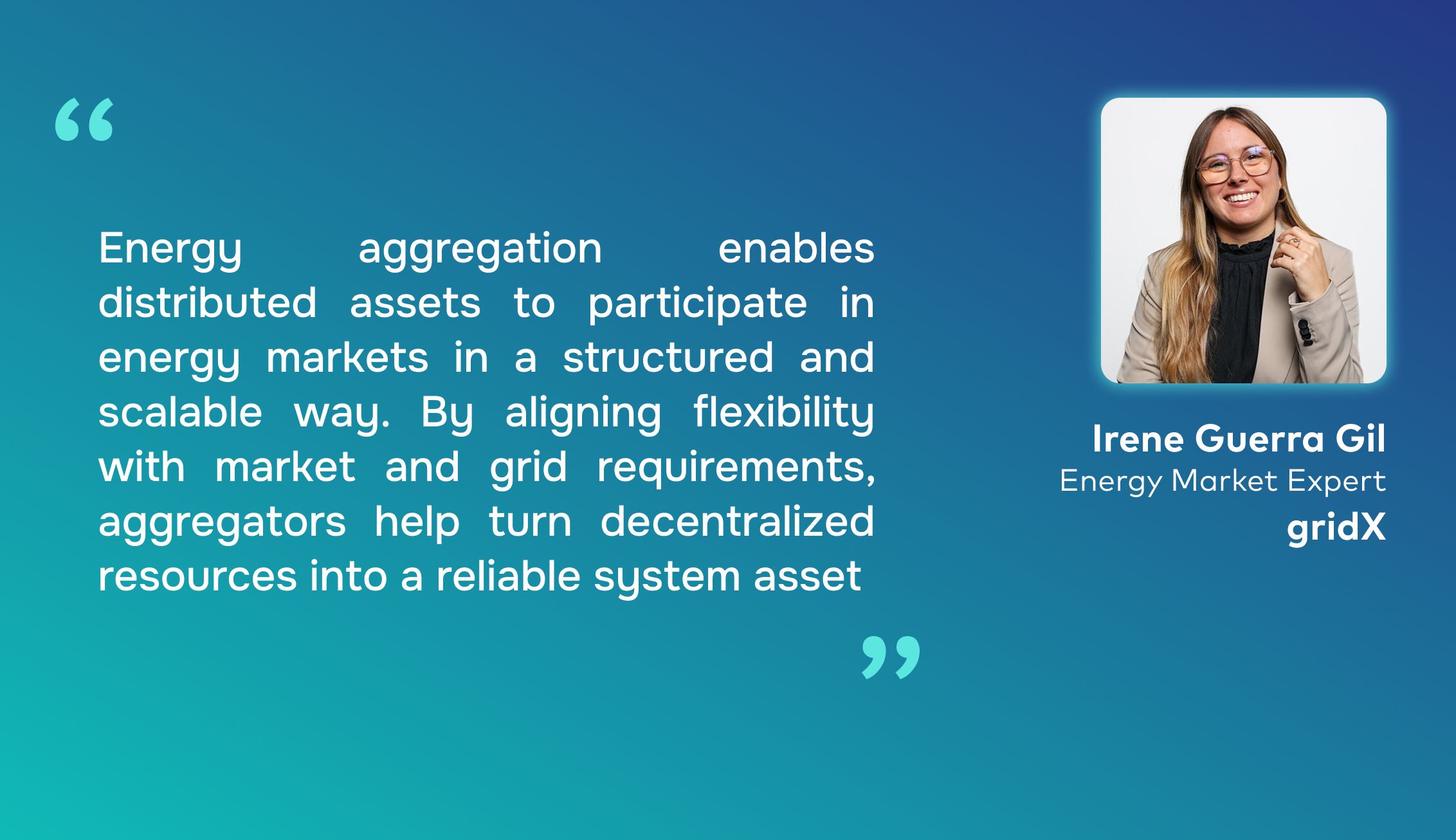
Flexibility markets are shifting towards better integrated distributed assets and reward responsive behavior. As regulatory frameworks evolve, aggregators are expected to play a stronger role in connecting decentralized flexibility with local, regional and cross-border market structures. Digital energy management systems continue to advance toward more automated and scalable coordination across diverse asset portfolios. gridX Energy Market Expert Irene Guerra Gil comments, that: “Energy aggregation enables distributed assets to participate in energy markets in a structured and scalable way. By aligning flexibility with market and grid requirements, aggregators help turn decentralized resources into a reliable system asset.”
Looking ahead, energy aggregation is expected to transition from a supporting mechanism to a core system function. With transparent orchestration and reliable market integration, distributed assets can operate as active participants in the energy system. This supports a resilient and efficient energy system where flexibility becomes a central component of system stability.